Stress vs. Anxiety: How to Tell Which One You’re Actually Dealing With
Stress vs. anxiety — most people use the words interchangeably, and it’s easy to see why.

In this article
- What Is Stress?
- What Is Anxiety?
- Stress vs. Anxiety: 5 Key Differences at a Glance
- When Does Anxiety Become a Disorder?
- What’s Actually Happening in Your Body
- The Problem With Chronic Stress
- What Actually Helps: Coping Strategies That Work
- When to Talk to Someone (and Why Most People Don’t)
- You Can Manage This — Here’s What That Looks Like
- Questions
Stress vs. anxiety — most people use the words interchangeably, and it’s easy to see why.
Your chest is tight. Your brain won’t stop. You’re exhausted but you can’t wind down.
Is that stress? Anxiety? Both?
Most people aren’t sure, and that’s not a personal failing — the two genuinely overlap in ways that make them hard to tell apart. But they have different causes, different timelines, and sometimes need different responses. If you’ve been trying to figure out which one you’re actually dealing with, this is a good place to start.
What Is Stress?
Stress is your body’s response to pressure (NHS – Anxiety & Stress). Call it work, exams, bills, deadlines, family responsibilities, or even good things like planning a wedding, the circumstances around us can leave us overwhelmed.
Unlike anxiety, stress has a clear cause you can identify in your life.
In an APA survey, 62% of 3000 adults in the United States reported stress at some point in their lives in 2025, and these figures continue to increase (APA.Org – Stress in America 2025).
A bit of stress is fine because it can push you to meet deadlines, prepare for exams, or complete a task at work. But it becomes a problem when:
- The pressure never seems to stop
- You can’t “switch off.”
- You feel constantly drained
- You start experiencing burnout
What Is Anxiety?
If you notice you get worried excessively even without an obvious trigger, you might be having anxiety (APA.Org – difference between stress and anxiety). The interesting thing is that anxiety can be a stress response, but that’s not all. It often lasts longer and can come with unpleasant symptoms such as:
- Insomnia
- Fatigue
- Difficulty concentrating
- Restlessness
- Physical symptoms like diarrhoea, heart racing, fast breathing, etc
Anxiety becomes an anxiety disorder when it is persistent and begins to interfere with your daily life (WHO – anxiety disorder).
As social circumstances continue to become more difficult, more people are struggling with anxiety and are unable to cope (Psychiatry.Org – American Adults and Anxiety).
Stress vs. Anxiety: 5 Key Differences at a Glance
When it comes to stress vs. anxiety, the differences become clearer when you put them side by side. Same goes for normal anxiety versus an anxiety disorder — two things that often get confused for each other.
| Stress | Anxiety |
| Usually has a clear external cause | May occur without a clear trigger |
| Improves when the situation resolves | Can persist even after the situation ends |
| Proportional to the situation | Often feels excessive or out of proportion |
| Feels like pressure or overwhelm | Feels like persistent worry or fear |
| Often improves with rest or problem-solving | May require coping strategies or treatment |
When Does Anxiety Become a Disorder?
Everyone gets anxious sometimes, but some people experience this anxiety in prolonged and intense forms that impair their normal lives. This is referred to as an anxiety disorder.
Key differences between normal anxiety and anxiety disorder are (NIH – I’m so stressed out!):
| Anxiety | Anxiety Disorder |
| A normal fearful response to stress | Excessive worry without a specific trigger |
| Often eases off as the trigger is sorted | Can go on for at least 6 months |
| Needed to survive (fright & flight) | Interferes with daily life |
| Can go away on its own | Requires treatment |
Anxiety disorder can show up in any of the following forms:
- Generalised Anxiety Disorder (GAD): Persistent excessive worry
- Panic Disorder: Recurrent panic attacks with ongoing fear of future attacks
- Social Anxiety Disorder: Intense fear of social situations
- Specific Phobias: Strong fear of specific objects or situations (Claustrophobia, Agoraphobia)
What’s important is getting help early, as these conditions can be treated.
What’s Actually Happening in Your Body
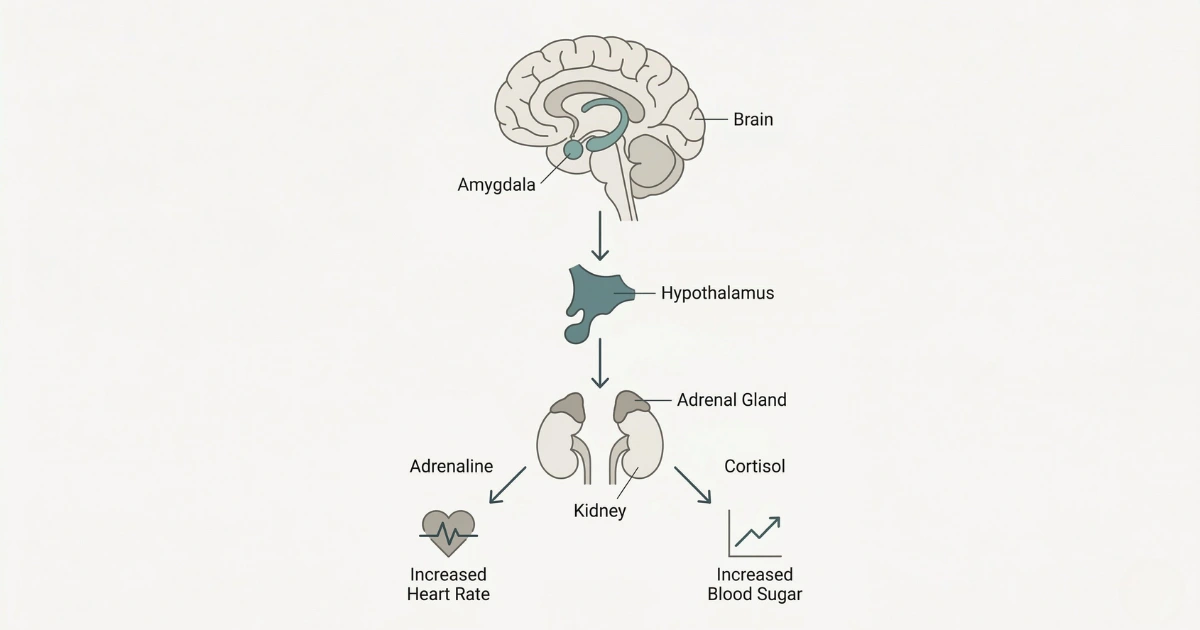
Stress begins as a survival mechanism in the brain that prepares your body to respond quickly to danger.
When a threat or stressful factor is perceived, the amygdala signals the hypothalamus, which activates the sympathetic nervous system (also known as the body’s fight-or-flight response).
This leads to the release of adrenaline, a hormone that communicates this survival response to your entire body. At this point, you might experience an increasing heart rate, breathing, blood pressure, and energy supply.
If the stress continues, your body also releases cortisol, a hormone that keeps the body on high alert by maintaining elevated blood sugar levels and sustaining your energy. In the short term, this system just helps you cope with all that’s happening.
However, stress can become chronic if nothing is done to put things in their proper place (Harvard Health – Understanding the stress response).
The Problem With Chronic Stress
Most people continue to harbour stress until it becomes a load they carry. If you’ve been under ongoing stress but are not concerned, you should be.
Under chronic stress, the continuous release of stress hormones like cortisol can negatively affect the body.
Persistently high cortisol levels can contribute to high blood pressure, weakened immunity, metabolic disturbances, and changes in brain function (Science Direct – Chronic Stress).
In essence, stress and anxiety might benefit the body if short-lived, but are harmful when they happen constantly.
What Actually Helps: Coping Strategies That Work

Managing stress and anxiety looks different for everyone, but some approaches have solid evidence behind them. These aren’t quick fixes — they work best when practiced consistently.
Write your thoughts down. There’s something clarifying about getting your worries out of your head and onto a page. Research supports journaling as a useful tool in managing mental health symptoms — not because it solves the problem, but because it helps you see it more clearly, which makes it easier to address (PMC – Efficacy of journaling in management of mental illness). Even five minutes before bed can make a difference.
Try relaxation or mindfulness techniques. Breathing exercises and grounding practices work by giving your nervous system a signal that it’s safe to stand down. Simple techniques like box breathing — inhaling for four counts, holding for four, exhaling for four, holding for four — can interrupt the stress response before it escalates. You don’t need an app or a quiet room. You just need a few minutes.
Move your body and eat regularly. Exercise helps regulate the stress hormones — cortisol and adrenaline — that keep your body on high alert. It doesn’t have to be intense; even a daily walk makes a measurable difference over time. Eating balanced meals matters too, because skipping meals or relying on caffeine and sugar can amplify anxiety symptoms and make it harder to think clearly.
Get consistent sleep. Poor sleep and stress feed each other in a cycle that’s genuinely hard to break. Stress disrupts sleep; poor sleep makes stress harder to handle the next day. A consistent sleep routine — same bedtime, same wake time, even on weekends — helps regulate your nervous system over time and gives your body a better baseline to work from.
Cut back on caffeine. Caffeine stimulates the same physiological response as stress — elevated heart rate, increased alertness, heightened reactivity. If you’re already running on a stressed or anxious nervous system, caffeine can push symptoms over the edge. This doesn’t mean cutting it out entirely, but paying attention to how much you’re having and when can make a noticeable difference.
Talk to someone. Sharing what you’re going through — with a friend, a family member, or a support group — reduces the weight of carrying it alone. There’s real value in being heard by someone who gets it, and peer support can complement other coping strategies in ways that solo management can’t always replicate.
When to Talk to Someone (and Why Most People Don’t)
If you feel like you’re barely coping, or your stress or anxiety just isn’t settling no matter what you try, it might be time to speak to a health professional.
In a mental health poll conducted by the American Psychiatric Association, we see that on 24% of respondents with anxiety actually sought help (APA – Annual Mental Health Poll)
You don’t have to wait until things feel unbearable.
With the right help, you can get your mental health sorted.
After a chat with your doctor, you might be offered treatment options such as psychotherapy (also known as talk therapy) or medications (NHS – Talking Therapies).
Most people might benefit from a combination of both.
You Can Manage This — Here’s What That Looks Like
Many people live with stress or anxiety every single day, sometimes without even realising how much it’s affecting them. But the good news is that with the right coping strategies and professional help, you can live a confident and fulfilling life.
Questions readers ask
What is the difference between stress and anxiety?
Stress is typically a response to something identifiable — a deadline, a difficult conversation, a financial pressure. It tends to ease once the situation resolves. Anxiety is more persistent. It can show up without a clear trigger, lasts longer, and often feels out of proportion to what’s actually happening.
Can you have anxiety without knowing what’s causing it?
Yes, and this is one of the clearest signs that what you’re experiencing is anxiety rather than stress. Stress almost always has a source you can point to. Anxiety can surface even when circumstances are calm — which is part of what makes it harder to manage on your own.
How long does anxiety last compared to stress?
Stress typically fades when the pressure does. Anxiety can linger well after the situation has passed — and in the case of an anxiety disorder, symptoms may persist for six months or longer without a specific trigger maintaining them.
What are the physical symptoms of anxiety?
Anxiety isn’t just a mental experience. Common physical symptoms include a racing heart, rapid breathing, fatigue, difficulty concentrating, restlessness, and gastrointestinal issues like nausea or diarrhea. These are your nervous system responding as if there’s a threat — even when there isn’t one you can see.
When does anxiety become an anxiety disorder?
Anxiety crosses into disorder territory when it’s persistent, excessive, and starts interfering with your daily life. A general guideline used in clinical settings is symptoms lasting six months or more. Anxiety disorders include Generalized Anxiety Disorder (GAD), Panic Disorder, Social Anxiety Disorder, and specific phobias.
Can stress turn into anxiety?
It can. Anxiety is sometimes a stress response that outlasts its trigger — your nervous system stays activated even after the stressor is gone. Over time, unmanaged chronic stress can contribute to the development of anxiety symptoms or disorders.
When should I seek help for stress or anxiety?
If what you’re feeling isn’t easing with rest, lifestyle changes, or basic coping strategies — or if it’s affecting your work, relationships, or sleep on a regular basis — it’s worth talking to a healthcare provider. You don’t have to be in crisis to ask for support. Research suggests only around 24% of people with anxiety actually seek help, which means most people are managing more than they need to alone.
Written by
 Dr. Chiamaka Wisdom-AsotahSpecialty Registrar, NHS England · MBBS, MPH
Dr. Chiamaka Wisdom-Asotah is a medical doctor and global health professional holding an MBBS and a Master of Public Health from Keele University.
Full bio: Dr. Chiamaka Wisdom-AsotahReviewed by
 Bree SharpEditor
Reviews every article against our editorial standards before it’s published.
Our editorial standardsThis article is for general wellness and educational purposes only. It is not a substitute for professional medical advice, diagnosis, or treatment. Always consult a qualified healthcare provider before making changes to your health routine, including the use of supplements, especially if you are pregnant, breastfeeding, taking medication, or managing a medical condition.