Anxiety Feels Endless. Here’s Why — and What Actually Helps.
This guide is meant to help you understand anxiety as a whole — what it is, why it feels the way it does, and where to go next if a specific part of this experience feels familiar to you.

In this guide
- What Is Anxiety, Actually?
- How Is Anxiety Different From Worry & Stress?
- What Does Anxiety Do Biologically?
- Everyday Anxiety vs. Chronic Anxiety vs. Anxiety Disorders
- Types of Anxiety
- How Does Anxiety Affect the Brain & the Body?
- Why Does Anxiety Feel Endless?
- What Actually Helps With Anxiety?
- When Professional Support Matters
- Therapy Styles
- Anxiety Medication
- The Way Forward
- Questions
Ever felt an impending sense of doom when thinking of turning up at work, sorting out your finances, or just showing up at university or school? Have you felt that performance pressure — not the kind that makes you perform better but makes you want to draw the curtains, lock the door, and stay shut in your room? If you answer yes to that, chances are you aren’t just worried…you are battling anxiety.
Anxiety is like a chimera with many heads. It’s the same yet subtly different for every individual. That’s why we wrote this article, to help you better understand what anxiety is and how to cope with it. We aren’t here to tell you what to do, but to make you feel seen and heard.
This guide is meant to help you understand anxiety as a whole — what it is, why it feels the way it does, and where to go next if a specific part of this experience feels familiar to you.
If healing and leading a better life are what you need, read on.
What Is Anxiety, Actually?
Anxiety is an emotion, one that’s designed to keep you safe (American Psychiatric Association, WHO). Think of it as an overprotective parent or sibling. They may prohibit you from stepping out late at night or if it’s snowing. It feels bothersome, yes, but you know they mean well. However, this overprotection becomes a problem when they don’t let you go to the movies with friends or leave for spring break.
That’s what modern anxiety is — an overprotective parent or sibling whose desire to look out for you stems from a place of perceived threat. In real life, your brain plays this ‘overprotective parent/sibling’ role and for good reason. Anxiety is designed to ensure your continued existence. The emotion by itself is not the problem. How it functions is. But before we discuss anxiety in detail, it’s necessary to separate emotions like worry, stress, and anxiety.
On the surface, worry, stress, and anxiety all feel similar. That is why it’s important to differentiate them based on how each of them feels.
How Is Anxiety Different From Worry & Stress?
Worry is an emotion that stems from all the ‘what if’ questions we ask ourselves. Let’s say you have a pot of milk on the stove and you need to take a leak. You worry that the moment you look in the other direction is when the milk will boil and spill over. It’s not debilitating, but something rooted in lived experience.
Stress is an emotion, too. It affects the mind and the body and often stems from the situation when you have worked hard for too long. Perhaps you are a doctor, and you are stressed about your private medical practice and showing up at the hospital you are associated with. Stress manifests often as irritability, stiff shoulders, and the feeling of wanting to give it all up.
Anxiety lives at the intersection of worry and stress (Harvard Health). While some degree of anxiety is normal — think the night before your SATs — it’s a cause of concern only when the ‘what if’ loops spiral out of control.
Anxiety, panic, and stress often get lumped together — especially in everyday conversation. But they’re not the same experience, and confusing them can make coping harder than it needs to be.
If you’ve ever wondered whether what you’re experiencing is an anxiety attack, a panic attack, or stress that’s tipped into something more chronic, we explore those differences in depth in Anxiety Attack Symptoms vs. Panic Attack Symptoms: Learn the Difference & How to Cope and Anxiety vs. Stress: How to Tell the Difference & Why It Matters.
What Does Anxiety Do Biologically?
Biologically speaking, anxiety exists to ensure our continued existence. Think of the time you were on the 51st floor of a skyscraper and afraid to peek out of the window to the street below. You are in a well-constructed building with reinforced glass windows, yet your brain treats the height and the edge of the floor as a threat. You know you are secure, but for your brain, you might as well be standing at the edge of a cliff, staring into the void below.
That weakness in your knees, the sense of nausea, and the fear of death are mechanisms the brain deploys to pull you away from the edge of the cliff, or in this case, away from the glass window on the 51st floor.
But then again, anxiety is a broad term. To better understand it, we need to differentiate between how different types of anxiety show up.
Everyday Anxiety vs. Chronic Anxiety vs. Anxiety Disorders
Everyday anxiety is somewhat like the one we discussed above. A better way to understand it is to think about the time you were low on mobile data, but you needed to step out. You get anxious, what if the mobile data runs out while you are out, and you can’t book a ride back home? Or, what if your friend texts you urgently and you are not able to respond right away?
In contrast, chronic anxiety feels like that knot in the stomach that carries over from one day to the next. For instance, you are due for a promotion at work in the next performance review — if all goes well. So you start worrying about putting your best foot forward. You want your work to be spotless and to be on great terms with your boss. This is when you start functioning from a place of anxiety — anxiety of not missing out on that promotion, and it persists for the weeks and months to come. This is also what it’s called long-drawn-out anxiety.
When anxiety gets in the way of your everyday life, that is when it is labelled as an anxiety disorder. In the above two scenarios, you still step out of your house and still show up at work. But in the case of anxiety disorders, that becomes difficult. To be fair, anxiety disorder is a broad medical term — encompassing General Anxiety Disorder (GAD), Panic Attacks, Social Anxiety, Agoraphobia, and other phobias. We dive into details about this in the subsequent sections.
Types of Anxiety
As discussed in the sections above, anxiety is a broad term that often encompasses mild to severe anxiety. Differentiating them is the first step towards understanding what’s ailing us and how we deal with it.
General Anxiety Disorder (GAD)
General Anxiety Disorder, or GAD as it is often called, refers to anxiety without a fixed cause, as in the case of certain phobias. It is defined by excessive and uncontrollable worry about everyday life events and activities. GAD involves a pervasive feeling of dread that lacks a specific focus and often persists even when there is no immediate threat.
GAD manifests as persistent worry with physical symptoms such as restlessness and fatigue, along with mental symptoms such as difficulty concentrating. For instance, you are anxious about the domestic chores you need to take care of after work. While there is no one fixed chore behind the anxiety, the mind invents reasons by indulging in what-if scenarios.
Social Anxiety
Social anxiety can be best summed up with the phrase ‘what will they think of me?’ It stems from the persistent fear of being watched, judged, rejected, or humiliated in social situations. Unlike GAD, social anxiety has a fixed cause — negative evaluation by others and peers in a social setting.
It’s important to point out that social anxiety does not stem from large crowds or a collection of people. It stems from the potential for scrutiny — a perceived threat that the mind blows out of proportion. Case in point, Raj from Big Bang Theory, who can deliver presentations but can’t speak with women out of fear of judgment and rejection.
Social anxiety triggers the fight or flight or freeze or fawn response. Those experiencing it report feeling clammy, going blank, stammering, and, in certain cases, avoiding social settings altogether because they feel self-conscious intensely.
Panic Disorder
Panic disorder is a type of anxiety disorder that is characterised by recurring and unexpected panic attacks of a severe nature (NIMH). Unlike GAD, panic disorder is a sudden and intense surge of fear — often debilitating — and without a clear trigger.
Panic attacks are the core component of panic disorders. It peaks quickly, often in as little as 10 minutes, and occurs because the body’s fight or flight system has misfired. It manifests as chest pain, dizziness, and shortness of breath, accompanied by sweating and nausea. The symptoms are so severe that those experiencing an episode often believe they are having a heart attack or worse — dying!
Panic disorder arises when individuals who experience it get anxious about having another episode. This anxiety then tends to contribute to future attacks, with each recurring attack reinforcing this anxiety. In certain cases, people tend to avoid situations that tend to set off panic attacks (agoraphobia), which in turn can affect their quality of life significantly.
We will not elaborate any further on what having a panic disorder feels like. The idea here is to make you feel seen, not overwhelm you.
Health Anxiety
Health anxiety is somewhat like GAD in the sense that the person in question has an overwhelming fear of developing a serious illness, such as Cancer or COVID-19 (Cleveland Clinic, NHS). This is an all-consuming belief, often stemming from self-misdiagnosis of symptoms or blowing them out of proportion.
For example, you may have the stomach bug, which normally goes away on its own in three to five days. However, by day two, based on online searches, you conclude that what you actually have is some form of stomach or intestinal cancer!
Health anxiety can lead to the patient undertaking “cure shopping,” where they willfully bounce between doctors and tests in the hope of finding a cure. On the other hand, other experiencers tend to avoid any medical interaction whatsoever to the extent of skipping necessary tests and mandatory checkups out of anxiety of their worst fears coming true.
High-Functioning Anxiety
High-functioning anxiety isn’t a clinically accepted term, but it’s used nonetheless to describe a form of anxiety that stems from the need for perfectionism and achievement. Unlike other forms of anxiety disorders, high-functioning anxiety is not obvious, as it’s masked.’ The individual experiencing it shows no symptoms that are generally associated with anxiety. They excel at their job, at social relationships, and in social settings.
Individuals with high-functioning anxiety are often winners and overachievers who operate from a place of fear of failure and the anxiety of appearing incompetent. They display increased productivity, better performance, and quick results…at least in the short-term. They often set impossible and impractical standards for themselves, regularly seek out validation, and engage in people-pleasing behaviors, including but not limited to overcommitting.
The best example here is a CEO or a sales manager who exceeds expectations not because of their talent or love for what they do, but because they are afraid of losing the next promotion or their job. They also feel guilty when not working or being productive.
Behind the veil are the usual symptoms of anxiety disorders, namely irritability, fatigue, and digestive issues. But they also show the need for control, will refuse to take breaks, and will tend to use productivity as an escape mechanism.
High-functioning anxiety often flies under the radar because it looks like competence. Productivity, reliability, and achievement can mask chronic fear and self-pressure for years.
This pattern is explored further in The Swan Effect: Understanding High-Functioning Anxiety, including why it’s so hard to recognize — even in yourself.
Whatever the form of anxiety, the result is the same — individuals functioning from a place of fear, one that gets in the way of their everyday life and that of their loved ones. While we all experience anxiety to some degree, experiencing anxiety disorders doesn’t make you weak, especially in this day and age.
How Does Anxiety Affect the Brain & the Body?
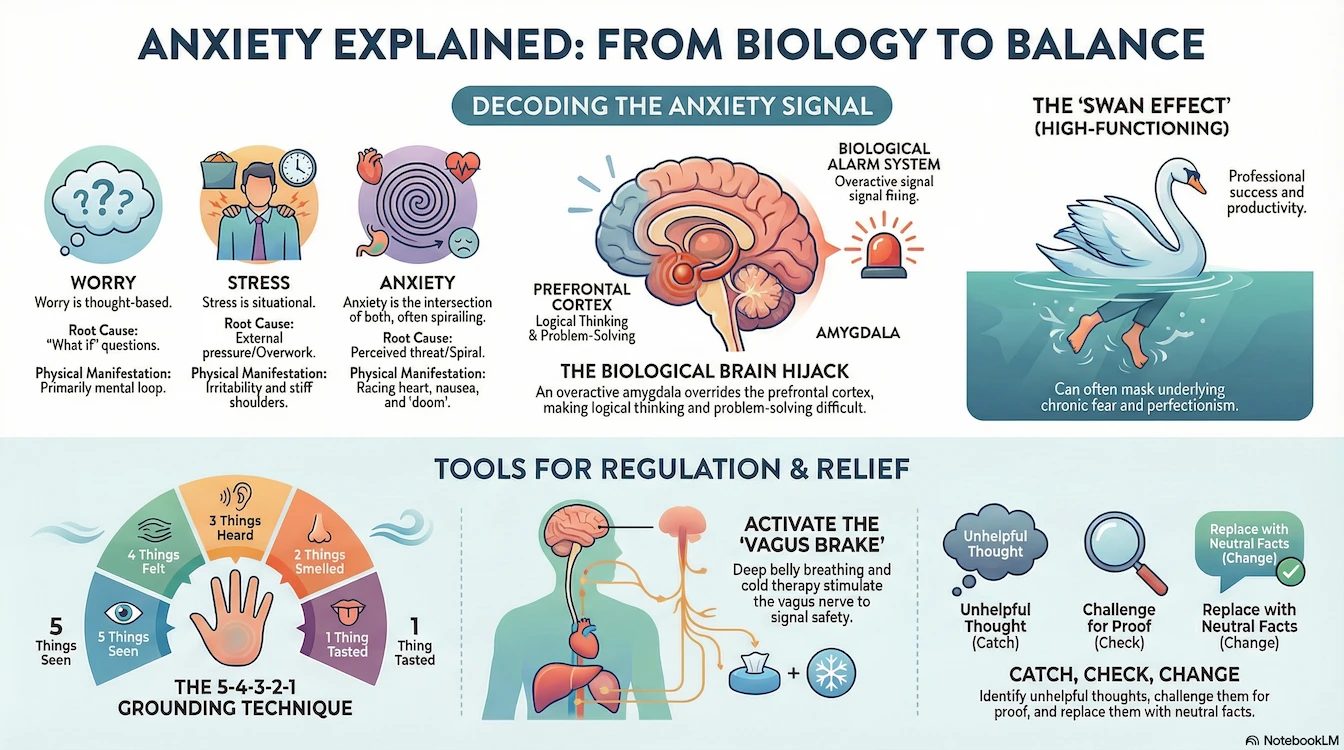
Caption: Visual overview of how anxiety differs from worry and stress, how the brain’s alarm system works, and why high-functioning anxiety can mask chronic fear.
Anxiety affects the brain and the body in a myriad of ways.
Anxiety doesn’t just live in thoughts. It shows up in the body — sometimes loudly, sometimes in strange, hard-to-explain ways. Chest tightness, dizziness, nausea, muscle tension, and fatigue are all common and often frightening if you don’t know what’s happening.
Fight, Flight, Freeze, & Fawn
When dealing with anxiety, people often mention freezing up at the moment they experience it. Others mention fleeing from the stressor, while others report becoming aggressive in the face of perceived threat. Fawn is a response that was identified later. While not as common, many display it, especially when dealing with authority figures at work or in public, as a way of dealing with their anxiety.
How Anxiety Affects Your Nervous System & Hormones
Anxiety triggers the amygdala in the brain — the region associated with stress, worry, and fear, amongst others (Harvard Health). However, modern research suggests the amygdala plays a small part in the overall process.
Researchers now agree that neurotransmitters such as GABA, Glutamate, and Serotonin play a greater role when it comes to anxiety (NIH). It is only when they stop working that anxiety becomes difficult to manage.
While the cause behind these malfunctioning hormones remains unclear, persistent stress, worry, and everyday anxiety are thought to be contributing factors. When the amygdala and these neurotransmitters don’t play nice, your nervous system bears the brunt.
You end up with a nervous system akin to a smoke alarm that is always watching and worse — firing up at the wrong moment and refusing to turn off despite you wanting to. This, in turn, affects thinking.
Why Does Thinking Get Harder When Anxious?
Thinking normally engages the prefrontal cortex — a region of the brain that’s tasked with problem-solving and logical thinking. Anxiety sends your amygdala into overdrive, which then hijacks the prefrontal cortex.
The brain shifts most of its energy towards scanning perceived threats, as a result of which you feel on ‘edge’. Additionally, the cortisol and adrenaline in your veins prevent the parasympathetic nervous system from kicking in. Cortisol also interferes with the hippocampus, which results in you blanking out during viva voce and boardroom presentations as your memory fails to recall a fact.
Normally, this ‘no-thinking’ works in our favour. If you had to think every time a car tried to run into you, you’d probably not make it. It’s this instantaneous reaction that makes you leap out of the car’s way in a split second as your conscious brain plays catch-up.
However, in the case of modern anxiety, the systems designed to keep us safe from predators and environmental stress end up shackling us.
Why Does Anxiety Make You Feel Worse?
Anxiety, whether mild or chronic, triggers the fight or flight system and then refuses to turn it off. It hijacks regions in your brain, prevents certain regions from functioning optimally, and releases a flurry of hormones while inhibiting others.
There’s a host of activity happening in your body internally that takes a few seconds to trigger. This surfaces as irritability, feeling tense (feelings of impending doom), feeling weird because as hormones play havoc, or in certain cases, feeling numb altogether as the body freezes up in the face of heavy emotional load.
None of this makes you weak. It’s how the body is designed to function in the face of anxiety.
Why Does Anxiety Feel Endless?
Anybody living with anxiety will tell you that it feels endless. It spills over from one day to the next and doesn’t switch off even when you need it to — somewhat like the overactive smoke alarm we mentioned earlier.
For some people, anxiety also shifts with life stages, hormonal changes, prolonged stress, caregiving, grief, or major transitions — which can make it feel like it appeared “out of nowhere.”
Behind this ‘endless’ feeling are reasons, which we explore here in this section.
For many people, anxiety feels the worst first thing in the morning — before the day has even started! This isn’t random, and it doesn’t mean you’re failing at coping.
The Feedback Loop in the Brain
The chief cause of the feeling endless is the feedback loop in the brain. In medical parlance, we call it the anxiety spiral. Imagine it’s 2020 and you have a cough out of the blue. Your mind races as you try to join the dots. You search online for COVID symptoms, all the while painting doomsday scenarios in your head. Your body releases cortisol and epinephrine as the amygdala goes into hyperdrive.
The heightened physical symptoms based on this perceived threat lead your brain to believe something is indeed wrong. Moreover, you start feeling anxious about the anxious thoughts you have at the moment. Since there’s nothing wrong, the crisis doesn’t resolve, and this creates a loop in the brain.
One of the most common anxiety loops today involves health fears — noticing a sensation, Googling it, and spiraling from there. This pattern can be exhausting and deeply convincing.
If this sounds familiar, The Google Spiral: Breaking the Cycle of Health Anxiety (Hypochondria) goes deeper into how this loop forms and how to interrupt it without dismissing real health concerns.
Nervous System Conditioning & Avoidance Patterns — Agoraphobia
Another prime cause of ‘endless anxiety’ is the nervous system conditioning that takes place with each moment of anxiety, whether chronic or spontaneous.
The best way to understand is to revisit our section on social anxiety. The fear of judgment gets the individual anxious. This fires up the fight or flight response, resulting in physical symptoms such as a racing heart, knots in the stomach, and weak knees. To the brain, this perceived threat is very real. Instincts kick in, and the individual in question refuses to attend the social event altogether.
This avoidance feels cathartic in the short-term. However, it reinforces the belief that the threat wasn’t imagined but very real. The next time the individual needs to attend a social event, they immediately choose to avoid it since the brain associates avoidance with relief. This is a form of reinforcement learning — a nervous system conditioning, if you will, that ends with Agoraphobia, i.e., avoiding places, events, and settings which can trigger anxiety.
To understand how Agoraphobia plays out in real life, we suggest watching the following YouTube video (Psychiatric Interview, University of Nottingham)
The Role of Shame in Anxiety
Though less spoken of, shame plays a key role in ensuring anxiety feels endless, and that feedback loop in the brain stays open. Experients (those who share this experience) often ask themselves questions along the lines of “what’s wrong with me” and “why can’t I be normal like others.”
These questions are often in response to the continued anxiety or certain episodes and stem from feeling weak, anger, and from a place of feeling ‘not-enough.’ Shame is like the lubricant that greases the gears of anxiety. It not only reinforces the self-belief around ‘I am broken’ or ‘I am beyond repair’ but also feeds into avoidance and eventually agoraphobia as described in the section above.
We’d like to point out that feeling inadequate on account of anxiety is not uncommon. However, just like the perceived threats we speak of, the feelings of being broken, weak, or not-enough are just that…a false perception.
For some, anxiety is shaped by past experiences or long-term emotional stress. For others, it develops without a clear emotional cause. Both are valid — and both are manageable with the right support. You are not weak or inadequate. You matter. The best thing about anxiety is that it’s manageable and treatable.

What Actually Helps With Anxiety?
With so much noise on the internet, finding what helps with anxiety gets chaotic quickly.
Managing anxiety isn’t about forcing calm — it’s about helping the nervous system feel safe enough to stand down. If you want to go deeper into specific tools and patterns, the following guides break them down in detail:
Adaptogens for Stress: Benefits, Safety, and What Research Shows
Get Out of Your Head: 10 Grounding Techniques That Actually Work
That’s why we outline here only the stuff that’s proven to work, by the medical literature, or experience; helping you separate the noise from the signal.
Slow Nervous System Calming
Slow nervous system calming is a simple way to establish some degree of control over your anxiety. There are multiple ways to do it, and we suggest you try them out to learn what works best for you.
- Vagus Nerve Stimulation: The vagus system is the body’s built-in brake system. To activate it, doctors suggest deep belly breathing (breathe in through the nose for 6 seconds and out of the mouth for 8 seconds), mindfulness meditation, light exercise, and most importantly, gentle massages. You can also chant, hum, or sing. These have been shown to stimulate the vagus nerve, too.
- Cold Therapy: Cold therapy is known to work by shocking the body and bringing attention to the present moment. There are various ways to do it, from splashing your face in cold water to taking cold showers (or an ice bath, if that’s something you want to do). In fact, cold therapy is one of the cornerstones of the Wim Hof method, which some people find helpful.
- 5-4-3-2-1 technique: The 5-4-3-2-1 technique is a grounding technique that is easy to execute and gently slows down the nervous system. Begin by naming 5 things you see, 4 things you can touch, 3 things you can hear, 2 things you can smell, and 1 thing you can taste. This technique forces your brain to focus on the senses as well as the present moment, thereby effectively breaking the anxiety loop.
Thought Patterns
In the section above, we spoke at length about the feedback loop in the brain. Unhelpful thoughts trigger anxiety, which further triggers unhelpful thoughts that often begin with ‘what if…’ The trick lies in breaking the loop, and here’s how you can effectively do it:
- Catch, Check, Change: Coined by the NHS, Catch it, Check it, and Change it is a technique designed to catch unhelpful thoughts as they arise, check or challenge the thought by asking for proof, and then change the thought to a positive or neutral one. For example, the voice in your head says that you’ll blow up your presentation at work. Ask it for proof (asking ‘why’ helps). Often, there’ll be no proof, at which point you know that there’s no reason to worry. Chances are you’ll do okay, or better yet, do better. You won’t be able to turn every negative thought into a positive one, and that’s okay, too. (NHS)
- Practice Positive Self-Talk: If you dismiss yourself whenever you have a negative thought, chances are that thought takes root. To change the narrative, talk gently to yourself — just like you’d talk to a friend who’s in trouble.
- Limit Social Media Exposure: if your social media feed is filled with ‘what’s going wrong in society’ and doomsday scenarios, chances are you are thinking along those lines and getting anxious about the future, but you can’t place your finger on one particular thing. Instagram now allows you to curate more of what you see, but the best option is to simply limit the amount of social media time. You can also take some time off from social media, spending it on a hobby instead.
Lifestyle Choices & Support
Lifestyle choices can effectively arrest the progress of anxiety, nipping it in the bud in certain cases. Contrary to popular belief, these choices don’t need you to jump through hoops or go out of your way to do so. Instead, these are simple, gentle practices that can fit into your routine.
- Sunlight Therapy: Stepping out in the sun after waking up early in the morning has multiple benefits. Sunlight boosts serotonin levels — the neurotransmitter that’s inversely associated with anxiety. Sunlight also helps reset the body’s circadian rhythm and has been shown to address Seasonal Affective Disorder (SAD). Make sure not to look directly at the sun when out since it can damage your eyesight. Also, make sure to apply sunscreen if stepping out into the sun later in the day. (Cleveland Clinic, MAP Clinic)
- Movement: We mentioned the somatic effects of anxiety — sweaty palms, weak knees, stiff shoulders, just to name a few. It’d not be wrong to say that anxiety lives in the body. That’s why movement helps. And the best part is you don’t need to hit the gym to tame your anxiety. Gentle practices like tai chi, yoga, and qi gong – even just 30 minutes of walking – often work better simply because they are more accessible. There are plenty of free resources on YouTube as well as community centers that can help you get started.
- Diet & Routine: Though often overlooked, diet and routine often play a very important role in making it or breaking it when it comes to anxiety. Fast foods — often rich in simple carbohydrates and sugar — result in a higher glycemic index, which in turn makes you jittery, which in turn raises anxiety levels. Instead, opt for foods with healthy fats, whole grains, fruits, vegetables, nuts, and proteins — foods which have complex carbohydrates that lower the glycemic index and trigger the happy hormones serotonin and dopamine, which in turn lower anxiety levels. Eating three balanced meals a day at regular intervals also helps. (Harvard Health)
Grounding & Emotional Regulation
Grounding and emotional regulation can help lower anxiety. After all, anxiety is an emotion, and like every other emotion we experience, it can be managed.
- Nature Therapy: Walk barefoot on the soil or on the grass. You don’t need to hike for this; the park near your house or your lawn will suffice. This is a no-cost, no-frills technique that works like a charm.
- Hugs: Another no-frills technique that helps lower anxiety levels. Hug your pets, your kids, your significant other. And if you don’t have access to them right now, hug a pillow or hug yourself (butterfly hugs, where you tap the opposite shoulder one at a time)
- Happy Place: If you are a human, chances are you have a happy place — a memory of that one time at the beach or a quaint coffee shop on a rainy evening. When anxiety overwhelms you, go to your happy place. Focus on the sensations you felt back then: the gently settling calm, the smell of fresh coffee and petrichor, the wind in your hair, the sun on your skin, and the sound of waves crashing on the shore. The best thing about this technique is that your happy place need not be real. Imaginary happy places work just as well.
Gentle Exposure & Confidence Building
Earlier, we spoke about Agoraphobia, where people avoid situations that they think will trigger their anxiety. Maybe that one time you lost control of your car and ended up in a spin, and now the very thought of driving sends your heart racing…and not in a good way. And so you decide to give up driving altogether, instead finding refuge in the perceived safety of your home.
This helps in the short term, but over the course of time, it reinforces the belief that driving is super dangerous, when it’s clearly not the case. Gentle exposure to the perceived threat helps break the anxiety loop and builds back confidence. To accomplish this, you can try the following:
- In Vivo Exposure: Directly facing the anxiety-inducing situation, one small step at a time. For instance, if you have social anxiety, you can start facing the anxiety by visiting a park where you’ll be amongst people but less likely to be spoken to. Once this feels comfortable (because the brain realises there’s no actual threat), you can take things up a notch and visit a cafe and so on. (HelpGuide)
- Imaginal Exposure: Instead of visiting the place or situation that induces anxiety, you imagine it. Think of the anxiety that some face when it comes to riding the roller coaster. Here, you don’t jump into a roller coaster to face your anxiety but visualise it in the confines of your room, tackling one emotion at a time.
- Virtual Reality Exposure: This is a new technique that makes use of virtual reality (VR) technology to build an immersive experience of events and conditions that induce anxiety. For instance, VR can be used to simulate an auditorium full of people or sitting in an airplane to work with public speaking and flying-induced anxiety.
- Interoceptive Exposure: This method is used to work through the bodily symptoms of anxiety, such as palpitations, dizziness, and lightheadedness. Example: spinning in a room to induce light dizziness and then stopping. This helps the brain understand these sensations from a place of safety without inducing anxiety.
To better apply these techniques, use journals, thought-challenging logs, and progress tracking sheets to better see progress over time.
These methods may appear simple and doable by oneself, but they work best when administered by a licensed exposure therapist. If attempted alone, they should be approached gradually and stopped if distress becomes overwhelming. We discuss this in the following section.
When Professional Support Matters
Self-guided exposure therapy can help with mild anxiety. Even then, using self-help resources comes with a certain degree of risk — getting it wrong. More importantly, anxiety, stress, and other ailments often have overlapping symptoms that make it all the more difficult to self-diagnose.
This is all the more reason to seek the help of a licensed medical practitioner who can help you get better. You should also seek their aid if you notice any red flags.
Red Flags
Physical red flags: – Irregular heartbeat and palpitations. – Tightness in the chest – Stomach aches ( also, IBS flaring up) – Nausea – Constant fatigue – Trembling – Sweating – Dizziness –Trouble falling asleep.
Emotional and cognitive red flags – Excessive and uncontrollable worry – Impending sense of doom – Irritability and constantly being on edge – Brain fog and trouble thinking.
Behavioral red flags – Compulsive behaviours such as washing hands repeatedly to establish a sense of control. – Avoidance, i.e., actively avoiding people, places, and circumstances that trigger anxiety. – Social withdrawal due to fear of judgment.
Serious cases – Reaching out for alcohol or cigarettes as a coping mechanism. Feeds into the avoidance we discussed earlier. – Suicidal thoughts and thoughts around self-harm – Inability to function in daily life.
The above-mentioned red flags can be managed via therapy and medication if you reach out for help at the right time.
Treatment isn’t one-size-fits-all. Therapy styles, medications, and combinations vary — and finding what works often takes time.
A deeper, medically grounded breakdown is covered in Treating Chronic Anxiety: Therapy, Medication, and Finding What Works.
Therapy Styles
Cognitive Behaviour Therapy (CBT)
In a nutshell, with CBT, you identify, challenge, and replace negative thoughts with positive ones. In other words, you face the root cause of your anxiety and learn to move past it gently. CBT is demanding but not as scary as it seems. For example, roller coasters may make you anxious. But three rides later, you find the roller coaster ride doesn’t bother you as much, and you know the ride has been tested for safety before it opened to the public. In-Vivo Exposure, which we discussed above, is a part of CBT. (TherapyGroupofDC)
Acceptance & Commitment Therapy (ACT)
By contrast, ACT focuses on cognitive diffusion, and chances are, if you have been meditating, you might find overlaps between this and your practice. Where CBT is all about challenging your thoughts, ACT is all about observing your thoughts. You observe thoughts as they come while acknowledging that your thoughts are not you. You then watch them leave. No judgement. You create a space between your thoughts and you.
Dialectical Behavior Therapy (DBT)
DBT is a form of therapy that focuses on developing skills in mindfulness, emotional regulation, distress tolerance, and interpersonal effectiveness. It’s particularly useful for those whose anxiety stems from a place of overwhelming emotion. The focus is on accepting anxiety while learning to change thoughts and behavior.
Exposure Therapy
Exposure Therapy is exactly what it sounds like — exposing the individual to small stressors in a controlled setting to slowly help them overcome anxiety. We discussed it in detail in the section ‘Gentle Exposure and Confidence Building’.
Psychodynamic Therapy
This form of therapy involves working through past traumas to find the root cause and a possible reconciliation. Especially useful in cases involving social or interpersonal anxiety. This is a less structured form of therapy that prioritizes the patient-therapist relationship to work.
CBT is the most common form of therapy for people with anxiety. However, finding what works best for you may take a little while. Unlike what’s shown on TV and the internet, therapy doesn’t heal you in a day, and the choice of therapist matters as much as the therapy style.
Something else that matters is medication.
Anxiety Medication
Therapy is half of the equation when it comes to healing or managing anxiety. The other half is medication, and it’s important to be informed as to what’s out there. (Anxiety & Depression Association of America)
Daily Maintenance Medicines
In cases of General Anxiety Disorder, you can expect to be prescribed SSRIs and SNRIs. These help balance serotonin and norepinephrine levels in the body and establish equilibrium. These medicines are best for long-term treatment but typically take several weeks to show full effects.
What does it feel like? Individuals on SSRIs and SNRIs report a wide variety of feelings when it comes to feelings after starting their medication. Common feelings include lifting of mental fog, better energy levels, and feeling good. However, feeling numb, distressed, low libido, and erectile dysfunction have also been reported. If you experience any of these, speak with your medical practitioner at the earliest.
SSRIs and SNRIs don’t work effectively for everyone. Such people are often prescribed Buspirone. The drug targets anxiety receptors minus the side effects of SSRIs and sedatives, but visible results are slow, taking anywhere between two and four weeks.
As Needed Medicines
These medicines are stronger and only applicable for short-term use. Two common drugs administered are beta-blockers and Benzodiazepines.
Beta Blockers work by limiting the effect of adrenaline in the body and are given to address social anxiety and performance anxiety, especially the physical symptoms (Medical News Today, Mayo Clinic).
What does it feel like? Beta Blockers lower the blood pressure and widen the arteries and nerves to increase blood flow. This calms the nervous system, and users report a feeling of calm. They also report cold hands and feet and some degree of lightheadedness.
Benzodiazepines are like sedatives and are administered in cases of acute distress — such as severe panic attacks — where quick relief is required. The drug works by calming down the central nervous system very quickly, often between 30 and 60 minutes. However, the risk of addiction here is very real, and they are rarely used for long-term anxiety management.
Getting the right information and the right treatment for anxiety can often feel overwhelming, and it does. So much so that a large percentage of the population gives up before they begin. It is absolutely normal to seek help to manage your anxiety better and break free. Staying put and suffering in silence helps no one, and you are not weak for seeking help. There are many resources online, such as BetterHelp and Open Path Collective, that offer affordable treatment. Moreover, technology has democratised access to affordable therapy, no matter where you are.
The Way Forward
No individual is broken or weak for having an illness of the mind or body. Neither are you. While there may not be a straight answer to ‘why me?’, modern science has the answer to your anxiety.
Therapy, medication, and self-help actions such as nervous system reset and lifestyle choices can greatly help curb anxiety levels, making them manageable to live with. Anxiety disorders can become significantly more manageable — and for some people, symptoms may resolve over time — but anxiety itself is a normal human response that never disappears entirely. Remember, it’s an important bodily mechanism after all, one that ensures that you don’t get hit by a car or get a snake bite in the wilderness.
Modern anxiety is like the context-insensitive smoke alarm we spoke of earlier. But it’s not impossible to turn it off. The same goes for anxiety. While immediate healing may be a myth, healing isn’t. Your anxiety may get worse when you begin healing, and setbacks are normal. You’ll get better as long as you work with your therapist and have a desire to get better.
Made it this far? Why not read our article on 7 easy steps to soothe your nervous system at home? We figure you’ll like it. Curious why your mind wanders straight to worst-case scenarios the moment you stop being busy? Our guide to the default mode network explains your brain’s “idle state” and how it shapes your mental health. You can also check out our other articles and blogs on Anxiety for more in-depth information.
Questions readers ask
What is the difference between anxiety, worry, and stress?
Worry is thought-based — the “what if” loop that stays mostly in your head. Stress is a response to external pressure that affects both mind and body, usually tied to a specific situation. Anxiety lives at the intersection of both, but unlike worry or stress, it often persists without a clear cause and can spiral even when the original trigger is gone.
What does anxiety do to the brain?
Anxiety activates the amygdala — the brain’s threat-detection system — which then overrides the prefrontal cortex, the part responsible for logical thinking and problem-solving. This is why anxiety makes it hard to think clearly, remember things, or make decisions. Your brain is essentially in survival mode, scanning for danger instead of functioning normally.
Why does anxiety feel endless?
Anxiety feels endless because the brain learns from avoidance. Every time you sidestep an anxiety trigger, the brain registers that avoidance as proof the threat was real — reinforcing the loop rather than breaking it. Shame about having anxiety compounds this, keeping the cycle running even when nothing external is wrong.
What is high-functioning anxiety?
High-functioning anxiety describes people who appear to be thriving — high achievers, reliable, socially capable — but are driven by fear of failure rather than genuine confidence. Because it looks like success, it’s often the last thing a person — or those around them — would think to question. That’s what makes it so easy to miss for years.
What is the 5-4-3-2-1 grounding technique?
A sensory grounding exercise that interrupts the anxiety loop by pulling attention into the present moment. Name 5 things you can see, 4 you can touch, 3 you can hear, 2 you can smell, and 1 you can taste. It works because it forces the brain to shift focus from perceived threat to immediate, concrete sensory reality.
When should I seek professional help for anxiety?
Seek professional help when anxiety begins interfering with daily functioning — work, sleep, relationships, or basic tasks. Physical red flags include persistent chest tightness, heart palpitations, nausea, and fatigue. Emotional red flags include uncontrollable worry, a constant sense of doom, and social withdrawal. If avoidance, alcohol, or thoughts of self-harm are entering the picture, professional support becomes urgent, not optional.
What therapy works best for anxiety?
CBT is the most researched therapy for anxiety and the most commonly recommended starting point. ACT, DBT, and exposure therapy are effective alternatives depending on the anxiety type and what’s driving it. Finding the right fit between person, therapist, and approach matters as much as the therapy itself — what works well for one person may not be the right entry point for another.
Can anxiety be cured?
Not in the way a bacterial infection can be. Anxiety is a normal human response that doesn’t disappear entirely — nor should it, since it exists to protect you. What treatment does is recalibrate the system so anxiety stops firing at the wrong moments and in disproportionate ways. For many people, symptoms become significantly more manageable over time. For some, they largely resolve. The goal is a life where anxiety no longer runs the show.
Written by
 Pallab BanerjeeWellness Writer
Pallab Banerjee (everywhere on the internet as copybypb) is a versatile writer with a soft spot for everything wellness.
Full bio: Pallab BanerjeeReviewed by
 Bree SharpEditor
Reviews every article against our editorial standards before it’s published.
Our editorial standardsThis article is for general wellness and educational purposes only. It is not a substitute for professional medical advice, diagnosis, or treatment. Always consult a qualified healthcare provider before making changes to your health routine, including the use of supplements, especially if you are pregnant, breastfeeding, taking medication, or managing a medical condition.