Panic Attack vs. Anxiety Attack: What’s the Difference and How to Cope
Have you ever felt a wave of fear so intense you couldn’t think straight — heart hammering, chest tight, completely convinced something was seriously wrong — even though nothing had actually happened? You might have experienced a panic attack.

Key takeaways
- “Panic attack” is a clinical diagnosis defined by the DSM-5 — “anxiety attack” is not a medical term, but describes a real and valid experience of escalating worry and physical tension.
- Both trigger the same fight-or-flight response, but panic attacks hit suddenly and peak within minutes, while anxiety attacks build gradually and can linger for hours or days.
- The physical symptoms — racing heart, chest tightness, shortness of breath — are your nervous system’s survival protocol firing in the absence of real danger. They’re terrifying, but not dangerous.
- Conditions like thyroid disorders, cardiac arrhythmias, and inner ear issues can mimic panic attacks — ruling these out matters before assuming it’s “just anxiety.”
- Evidence-based treatments include CBT, SSRIs, and lifestyle changes — but in the moment, techniques like the 5-4-3-2-1 grounding method and slow exhale breathing can interrupt an episode within minutes.
- Panic attacks that go unmanaged tend to escalate into avoidance patterns and panic disorder — early intervention makes recovery significantly faster.
In this guide
- Panic Attack vs. Anxiety Attack: Are They the Same Thing?
- Panic Attack vs. Anxiety Attack: Key Terms to Understand
- Panic Attack vs. Anxiety Attack: What’s Happening in Your Body
- What Causes a Panic Attack?
- What Does a Panic Attack Feel Like? Symptoms to Know
- How Long Do Panic Attacks Last?
- How Is a Panic Attack Diagnosed?
- What Else Can Mimic a Panic Attack?
- Panic Attack and Anxiety Attack Treatments That Actually Help
- Panic Attack vs Anxiety Attack: How to Cope When It Hits
- Nocturnal Panic Attacks: When Panic Strikes During Sleep
- How to Reduce Panic Attacks Over Time
- What Happens If Panic Attacks Go Unmanaged?
- Questions
Have you ever felt a wave of fear so intense you couldn’t think straight — heart hammering, chest tight, completely convinced something was seriously wrong — even though nothing had actually happened? If you’ve searched “panic attack vs. anxiety attack,” you’re already asking the right question.
You might have experienced a panic attack — or what many people call an anxiety attack.
Here’s how one person described theirs:
“I always just feel so disoriented and dizzy, like I’m going to pass out. Everything starts to look surreal, which causes more panic. Such a strange thing. I hate it. It’s so scary even though I know I’m in no real danger.”
If that sounds familiar, you’re not alone. According to the World Health Organisation, anxiety disorders — which include panic attacks — affect up to 4.4% of people worldwide, and panic attacks occur more frequently in women than men. In the United States alone, an estimated 11% of adults experience at least one panic attack in any given year, and roughly 2–3% develop panic disorder.
In this article, we’ll clear up what’s actually happening during a panic attack, break down the panic attack vs. anxiety attack question in plain language — why so many people confuse the two, cover what your nervous system is doing behind the scenes, and walk through practical ways to cope when one hits — including what to do if panic strikes during sleep.
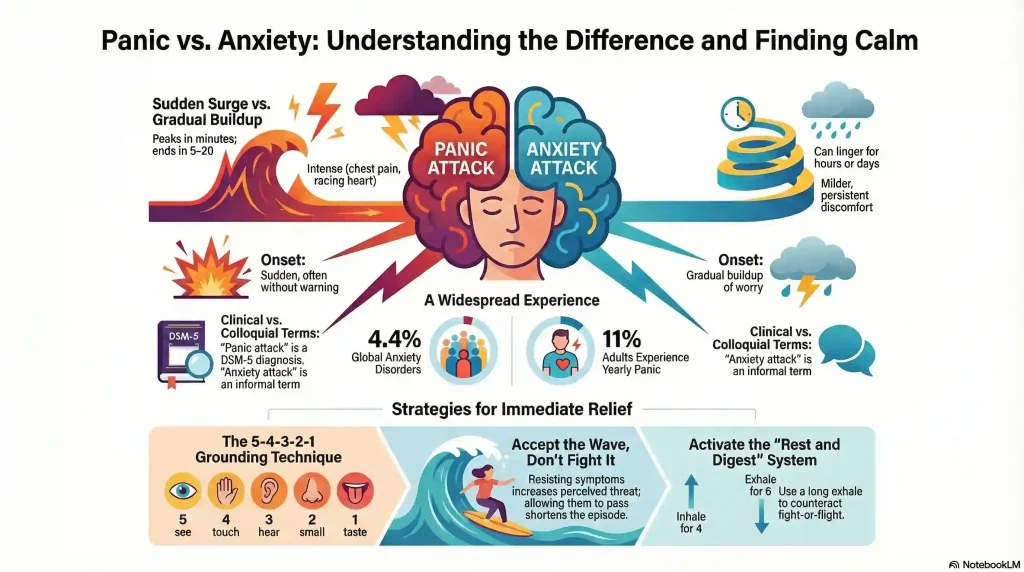
Too drained to read right now? No judgement. Watch ‘Panic Attacks, Explained: What’s Really Happening and How to Cope | Panic Attack vs Anxiety Attack’ on YouTube — we break down what’s really happening in your body and how to find calm.
Panic Attack vs. Anxiety Attack: Are They the Same Thing?
This is the question most people land here wanting answered — so let’s get straight to it.
“Anxiety attack” is not a clinical term. It doesn’t appear in the Diagnostic and Statistical Manual of Mental Disorders (DSM-5), which is the standard reference for mental health diagnoses. People use it in everyday conversation to describe a panic attack, or sometimes just a period of intense anxiety — but medically, there’s no separate diagnosis called an anxiety attack.
A panic attack, on the other hand, is a clearly defined clinical event: a sudden surge of intense fear or discomfort that peaks within minutes and comes with specific physical and psychological symptoms.
Here’s how a panic attack vs. anxiety attack compares in practical terms:
| Feature | Panic Attack | “Anxiety Attack” |
|---|---|---|
| Clinical term? | Yes (DSM-5 defined) | No — colloquial only |
| Onset | Sudden, often without warning | Gradual buildup of anxiety |
| Duration | Peaks within minutes, usually resolves in 5–20 minutes | Can linger for hours |
| Triggers | Often no obvious trigger | Usually tied to a stressor or worry |
| Physical symptoms | Intense — racing heart, chest pain, shortness of breath | Milder, but still uncomfortable |
| Fear of dying or losing control | Common | Less common |
| DSM-5 criteria | 4+ symptoms from a defined list of 13 | No formal criteria |
The short version: what most people call an “anxiety attack” is either a panic attack or a period of heightened anxiety. Knowing where you fall on the panic attack vs. anxiety attack spectrum matters, because the way you cope — and the support you might need — can differ.
Panic Attack vs. Anxiety Attack: Key Terms to Understand
A few definitions that help clarify how these experiences fit together:
Anxiety is a normal human response to stress. It’s the low-level worry you feel before a difficult conversation, a job interview, or a health concern. Everyone experiences it.
Anxiety disorder develops when that anxiety becomes persistent, hard to control, and starts interfering with daily life. It’s not just “being a worrier” — it’s a group of recognized conditions that affect how someone thinks, feels, and functions.
Panic attack is a sudden, intense wave of fear that peaks within minutes. The physical symptoms can feel dramatic and alarming — and they’re real, even when there’s no real danger present.
Panic disorder is diagnosed when someone has repeated panic attacks and begins either fearing the next one or changing their behavior to avoid situations where attacks might happen. This anticipatory anxiety — the fear of the next attack — is often what causes the most disruption to daily life.
In simple terms: anxiety is ongoing and stress-related. Panic attacks are sudden, intense, and short-lived. Understanding the difference between a panic attack vs. anxiety attack helps you recognize what’s happening and respond appropriately — because they can overlap, and panic attacks can be part of a larger pattern that becomes panic disorder.
Panic Attack vs. Anxiety Attack: What’s Happening in Your Body
To understand why panic attacks feel so physical — and so terrifying — it helps to know what your nervous system is actually doing during one.
A panic attack is essentially your body’s fight-or-flight response firing without a real threat. This response is managed by your autonomic nervous system, specifically the sympathetic branch, and it’s designed to prepare you for immediate physical danger.
When it activates, your body releases a surge of adrenaline and cortisol. This triggers a cascade of physical changes:
- Your heart rate increases rapidly to pump more blood to your muscles
- Your breathing speeds up to take in more oxygen
- Blood is redirected away from your digestive system toward your limbs — which is why you might feel nauseous or need the bathroom
- Your muscles tense in preparation for action, causing trembling or shaking
- Your pupils dilate, which can make lights seem brighter or surroundings feel unreal
- You start sweating to cool the body down in advance of physical exertion
Every single “symptom” of a panic attack maps directly to one of these fight-or-flight changes. There’s nothing random or broken about what’s happening — your body is executing a survival protocol. The problem is simply that it’s doing it at the wrong time, in the absence of actual danger.
Understanding this can be genuinely therapeutic. A CBT technique called interoceptive exposure works by safely triggering panic-like feelings on purpose. When you learn that your body’s alarm system isn’t dangerous, the fear response itself starts to shrink.
What Causes a Panic Attack?
The exact cause isn’t fully understood. Most research suggests panic disorder develops from a combination of factors rather than any single trigger:
- Stressful or traumatic experiences, such as bereavement, serious illness, or a major life change
- A family history of panic disorder or anxiety
- Changes in brain chemistry that affect how the nervous system responds to stress
- Overbreathing or hyperventilating, which can set off panic symptoms
- Patterns of catastrophic thinking — where the mind jumps to worst-case scenarios
- Sensitivity to internal body sensations (known as anxiety sensitivity), where normal changes like a slightly faster heartbeat are interpreted as dangerous
It’s worth noting that a panic attack can happen to anyone, even people who have never experienced significant anxiety before. First-time panic attacks often occur during periods of high stress, major life transitions, or after a significant health scare — and they can be just as intense for someone who’s never had one as for someone who’s had dozens.
What Does a Panic Attack Feel Like? Symptoms to Know
Panic attack symptoms tend to appear suddenly and feel overwhelming. Most episodes peak within 10 minutes and resolve within 20, though some feel longer — especially if attacks happen close together. The DSM-5 requires at least four of the following symptoms for a formal panic attack diagnosis:
Physical symptoms can include:
- Racing or pounding heartbeat (palpitations)
- Chest pain or tightness
- Shortness of breath or a feeling of being smothered
- A choking sensation
- Dizziness, lightheadedness, or feeling faint
- Sweating, chills, or hot flushes
- Shaking or trembling
- Numbness or tingling (paresthesias), often in the hands, feet, or face
- Nausea, stomach pain, or diarrhea
- Dry mouth
Emotional and mental symptoms can include:
- A sudden, overwhelming sense of fear or impending doom
- Fear of dying or having a heart attack
- Fear of losing control or “going crazy”
- Feeling detached from yourself or your surroundings (sometimes called derealization or depersonalization)
That last one — the surreal, detached feeling — is what the person quoted at the top of this article described. It’s disorienting, and it often makes the panic worse. Knowing it’s a recognized symptom, not a sign that something is deeply wrong with you, can help.
How Long Do Panic Attacks Last?
Most panic attacks peak within 10 minutes and resolve within 20. That said, the physical and emotional aftermath — feeling shaky, exhausted, or on edge — can last considerably longer. Many people describe a “washed-out” feeling for hours afterward, sometimes with residual muscle tension, headache, or fatigue.
Some people experience clusters of attacks, where one seems to lead into another. This can make it difficult to tell when one ends and the next begins, which is part of why panic attacks can feel so destabilizing even though each individual episode is brief.
It’s also worth knowing that “limited-symptom attacks” exist — episodes that have fewer than four symptoms and don’t meet the full DSM-5 criteria for a panic attack, but can still be distressing. If you’re regularly experiencing these, they’re still worth discussing with a healthcare provider.
How Is a Panic Attack Diagnosed?
Your doctor will start by asking about your symptoms — when they occur, how long they last, and what they feel like. Because panic attack symptoms overlap with several other health conditions, they’ll also want to rule out other causes.
This may include:
- A physical examination
- Blood tests (including thyroid function and blood sugar)
- An electrocardiogram (ECG) to check heart function
- A psychological assessment or questionnaire
This step matters: chest pain, a racing heart, and shortness of breath can have cardiac or respiratory causes that need to be ruled out before assuming anxiety is behind it. If you’re unsure, always seek medical advice — it’s much better to get checked and hear “it was a panic attack” than to dismiss a cardiac symptom.
What Else Can Mimic a Panic Attack?
This is an underappreciated piece of the puzzle. Several health conditions can produce symptoms that feel identical to a panic attack:
Heart conditions
Irregular rhythms (arrhythmias) or early cardiac issues can cause palpitations, chest pain, and dizziness that are easily mistaken for panic. Mitral valve prolapse, a common and usually benign heart condition, has long been linked to higher rates of panic-like symptoms.
Asthma and other breathing conditions
Chest tightness and difficulty breathing trigger fear responses that can look a lot like panic.
Other Conditions That Feel Like Panic
Sleep apnea
Waking up gasping, with a racing heart and a sense of dread, can feel exactly like a nocturnal panic attack.
Thyroid conditions
An overactive thyroid raises heart rate, causes sweating and restlessness, and can closely mimic panic.
Blood sugar changes
Low blood sugar in particular causes shaking, sweating, nausea, and a fast heartbeat.
Gut discomfort and abdominal pain can trigger a fear response that spirals into what feels like a panic attack. The gut-brain connection is well documented, and people with IBS have higher rates of panic disorder.
Chronic pain or inflammation
Ongoing physical stress can contribute to anxiety-like symptoms over time.
Caffeine and stimulants
High caffeine intake is one of the most commonly overlooked panic triggers. Caffeine stimulates the same sympathetic nervous system pathways involved in a panic attack, and in sensitive individuals, even moderate amounts can provoke symptoms.
This is why getting a proper diagnosis is important when weighing whether you’re experiencing a panic attack vs. anxiety attack — and why you shouldn’t assume anxiety is always the explanation without ruling out other causes.
Panic Attack and Anxiety Attack Treatments That Actually Help
Talking Therapy
Cognitive Behavioural Therapy (CBT) is the gold-standard treatment for panic attacks, and the evidence behind it is strong. It works by helping you recognize unhelpful thought patterns, understand what’s actually happening in your body during a panic attack, and build healthier responses.
A specific form of CBT called exposure therapy is particularly effective for panic disorder. It gradually helps you face feared sensations or situations — not all at once, but at a pace that allows your nervous system to learn they’re not dangerous. Over time, this can significantly reduce the frequency and intensity of attacks.
Another evidence-based approach is Acceptance and Commitment Therapy (ACT), which takes a different angle: rather than trying to reduce or eliminate panic symptoms directly, ACT focuses on changing your relationship with them. The goal is to accept uncomfortable sensations without fighting or fleeing them, while continuing to act in line with your values. For people who’ve found that traditional CBT didn’t fully resolve their panic, ACT can be a valuable alternative or complement.
Medication for Panic and Anxiety Attacks
Some people benefit from medication, particularly if panic attacks are frequent or severe. Antidepressants (SSRIs) are the most commonly used for long-term management. They don’t work immediately — most take 4–6 weeks to reach full effect — but they’re well-studied for panic disorder and are generally the first-line pharmacological option.
Benzodiazepines may be prescribed during an acute episode, but aren’t recommended for ongoing use due to the risk of dependence and tolerance. Some doctors prescribe SNRIs (serotonin-norepinephrine reuptake inhibitors) as an alternative to SSRIs.
Always consult your doctor before starting or stopping any medication.
Lifestyle Support
Whether you’re managing a panic attack vs. anxiety attack pattern, lifestyle changes aren’t cure-alls — but they’re not nothing either. Consistent sleep, reduced caffeine (a well-documented panic trigger), regular physical activity, and stress-management practices like mindfulness can all reduce the frequency and intensity of attacks over time. The evidence for regular aerobic exercise is particularly strong — multiple studies show it reduces anxiety sensitivity, which is one of the key vulnerability factors for panic disorder.
Panic Attack vs Anxiety Attack: How to Cope When It Hits
Knowing what to do in the moment can make a real difference — not necessarily in stopping the attack immediately, but in getting through it without making it worse.
Focus on your breathing
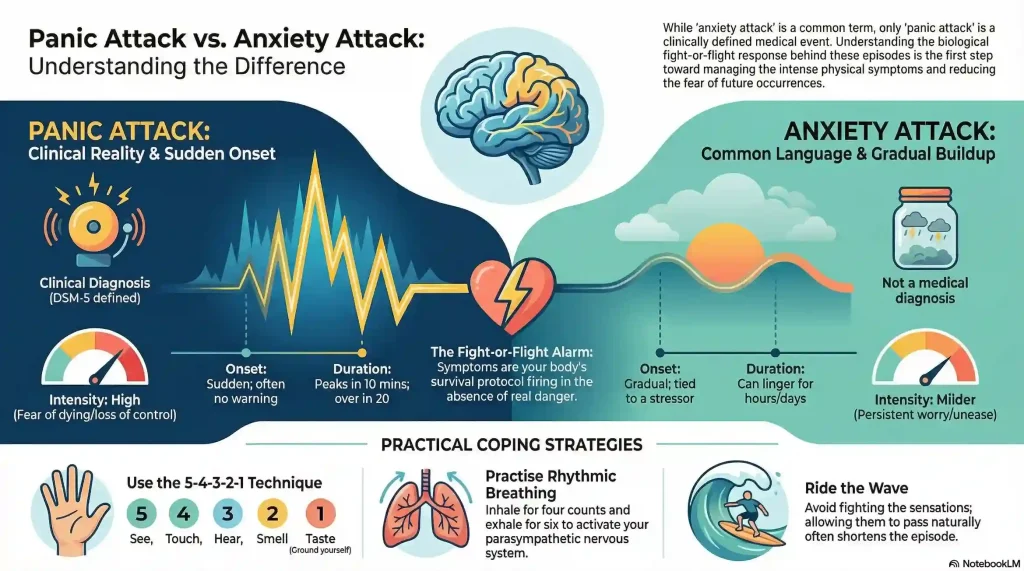
Breathe in slowly through your nose, out through your mouth. Counting each breath — in for four counts, out for four — gives your mind something concrete to hold onto and slows down the physical response. Some people find a slightly longer exhale (in for four, out for six) more calming, as this activates the parasympathetic nervous system, which counteracts the fight-or-flight response.
Stay where you are, if you can
The instinct to flee is strong during a panic attack, but leaving reinforces the idea that the situation was dangerous. Staying put — even if it’s uncomfortable — helps your brain update its threat assessment over time.
Use the 5-4-3-2-1 grounding technique
This is one of the most widely recommended grounding exercises for panic. It works by redirecting your attention away from the panic spiral and into the present moment through your senses:
- 5 things you can see
- 4 things you can touch
- 3 things you can hear
- 2 things you can smell
- 1 thing you can taste
You can also try chewing mint gum, holding something with a strong texture, or placing your hands under cold running water. The sensory input gives your brain something concrete to process other than fear.
Remind yourself it will pass
Panic attacks feel permanent while they’re happening. They’re not. The physical symptoms have a ceiling — your body cannot sustain peak panic indefinitely. The adrenaline surge that powers the attack is metabolized within minutes. It will end.
Avoid fighting it
This is counterintuitive, but resisting a panic attack often makes it worse. The more energy you spend trying to suppress the symptoms, the more your body reads the situation as threatening. Allowing the sensations to be present — uncomfortable as they are — tends to shorten the episode. Think of it less as “fighting the wave” and more as “letting it wash through.”
Nocturnal Panic Attacks: When Panic Strikes During Sleep
One of the most unsettling variants of panic is the nocturnal panic attack — waking from sleep in a state of full-blown panic, often with no dream or nightmare to explain it.
Nocturnal panic attacks involve the same symptoms as daytime attacks: racing heart, sweating, chest tightness, shortness of breath, and a powerful sense of fear. The difference is that you go from sleep to peak panic with no warning, which can make the experience even more disorienting.
Research suggests nocturnal panic attacks typically occur during the transition between light sleep stages — not during REM (dream) sleep — which means they’re not caused by nightmares. They’re driven by the same nervous system activation as daytime attacks.
If nocturnal panic attacks are happening to you:
- Keep a consistent sleep schedule, as sleep disruption can lower your panic threshold
- Avoid caffeine, alcohol, and heavy meals close to bedtime
- Keep your bedroom cool and comfortable — physical discomfort during sleep can contribute
- If you wake in panic, use the same coping techniques you’d use during the day: slow breathing, grounding, and reminding yourself that the attack will pass
- Talk to your doctor — nocturnal panic attacks respond to the same treatments (CBT, medication) as daytime attacks, and ruling out sleep apnea is important
How to Reduce Panic Attacks Over Time
There’s no guaranteed prevention, but these habits can reduce how often attacks happen and how severe they feel:
- Learn about anxiety and panic — understanding the mechanics takes some of the fear out of the experience
- Practice slow, controlled breathing regularly, not just during attacks
- Stay physically active; exercise is consistently associated with lower anxiety levels and reduced anxiety sensitivity
- Eat regular, balanced meals to avoid blood sugar swings
- Reduce or cut out caffeine, alcohol, and cigarettes — all of which can worsen symptoms
- Use CBT-based self-help resources (your doctor can point you toward reliable ones)
- Build a regular sleep routine — poor sleep quality is one of the most underestimated contributors to panic frequency
What Happens If Panic Attacks Go Unmanaged?
You can treat panic attacks effectively, but without support, they can start to shape daily life in ways that are harder to undo:
- Avoidance of places or situations associated with past attacks — sometimes expanding into agoraphobia
- Reduced confidence and quality of life
- Increased risk of depression
- Potential development of panic disorder
- Social withdrawal and isolation, particularly if attacks happen in public settings
- Substance misuse — some people turn to alcohol or sedatives to manage their symptoms, which can create additional problems
The earlier someone gets support, the less likely these patterns are to take hold. That’s worth keeping in mind if you’re on the fence about seeking help.
Wrapping Up
Panic attacks are frightening, exhausting, and deeply disorienting — especially when you don’t know what’s happening or why. But they’re also well-understood and treatable, and you don’t have to figure out how to manage them alone.
If panic is starting to affect your daily life, speaking with a healthcare professional is the right next step. And if you want to understand the broader landscape of anxiety — where panic attacks sit within it, what drives different types, and how they overlap — our anxiety pillar article covers the full picture.
Questions readers ask
What’s the difference between a panic attack vs. anxiety attack?
The core difference is this: a panic attack is a clinically defined event — sudden, intense, and DSM-5 recognized. “Anxiety attack” isn’t a clinical term at all. People use it to describe either a panic attack or a period of intense anxiety that builds gradually around a stressor.
Can you have a panic attack without knowing what triggered it?
Yes, and this is actually one of the hallmarks of panic disorder. Unexpected panic attacks — ones with no obvious trigger — are common, and they’re often what makes the experience so frightening. The absence of an identifiable cause doesn’t mean something is more wrong; it’s just how panic disorder often works.
How do you know you’re having a panic attack and not a heart attack?
It’s difficult to tell in the moment, and you shouldn’t try to diagnose yourself. Both can cause chest pain, rapid heartbeat, and shortness of breath. If you’re unsure — especially if it’s your first experience of these symptoms — seek medical attention. A doctor can rule out cardiac causes and give you a clear picture of what’s happening.
Can panic attacks cause diarrhea?
Yes. Stress hormones like cortisol and adrenaline released during a panic attack can speed up digestion as part of the fight-or-flight response, leading to stomach cramps or diarrhea. Gastrointestinal symptoms during a panic attack are common and not a sign of a separate problem.
Can anxiety attacks turn into panic attacks?
A period of high anxiety can sometimes escalate into a full panic attack, particularly if you’re hyperventilating or focusing intensely on physical sensations. Learning to recognize early anxiety signals — and using calming techniques before they build — can help interrupt this cycle.
Will panic attacks go away on their own?
Some people do experience panic attacks that resolve without treatment, particularly if they were linked to a specific stressor that’s since passed. For others, attacks recur and can worsen without support. If you’ve had more than one unexplained panic attack, or if attacks are affecting how you live or what you do, it’s worth getting a professional assessment.
Can you have panic attacks as a teenager?
Yes. Panic attacks can occur at any age, though they most commonly first appear in late adolescence or early adulthood. Teenagers may be less likely to recognize what’s happening, which can make the experience more frightening. If a young person is describing sudden episodes of intense fear with physical symptoms, it’s worth having them assessed — early intervention tends to produce better long-term outcomes.
Are panic attacks or anxiety attacks dangerous?
Panic attacks feel dangerous, but they are not physically harmful. Your body is running a survival response — it’s deeply uncomfortable, but it cannot injure you. The heart racing, the breathlessness, the dizziness — all of these are temporary effects of adrenaline and will resolve on their own. The main risk isn’t the attack itself, but the avoidance patterns and anxiety that can develop around them if left unaddressed.
Written by
 Dr. Chiamaka Wisdom-AsotahSpecialty Registrar, NHS England · MBBS, MPH
Dr. Chiamaka Wisdom-Asotah is a medical doctor and global health professional holding an MBBS and a Master of Public Health from Keele University.
Full bio: Dr. Chiamaka Wisdom-AsotahReviewed by
 Bree SharpEditor
Reviews every article against our editorial standards before it’s published.
Our editorial standardsThis article is for general wellness and educational purposes only. It is not a substitute for professional medical advice, diagnosis, or treatment. Always consult a qualified healthcare provider before making changes to your health routine.