

Your brain doesn’t stop when you’re not actively engaged; it just switches networks.
Picture this: You are sitting in a cafe having a snack all by yourself. You take a pause, look out the window, and before you know it, you are either on an imagined adventure, revisiting a memory, or speculating about the future. Or, perhaps it’s 1 am and your brain is painting ‘what if’ scenarios that revolve around your worst fears—breakup, job loss, and not being able to stand up for yourself.
If you have experienced any one of these, you have tapped into your Default Mode Network without necessarily knowing about it or how it works. If you feel seen and heard, and decide to read what follows, we guarantee you’ll walk away with something more than just technical knowledge. We aren’t just discussing the Default Mode Network here, but outlining how it ties to mental health, and most importantly—what you can do about it.
Let’s get started.
In This Article
- What Is the Default Mode Network?
- How Does the Default Mode Network Work?
- The Default Mode Network and Mental Health
- The Default Mode Network and Depression
- The Default Mode Network and Anxiety Disorders
- The Default Mode Network and Stress
- The Triple Network Model: DMN, CEN, and the Salience Network
- How a Compromised Default Mode Network Shows Up in Daily Life
- Establishing Homeostasis: How to Calm an Overactive DMN
- Frequently Asked Questions
- Your Brain’s Idle State Shapes Your Mental Health
What Is the Default Mode Network?
Simply put, the Default Mode Network (DMN) is a system that connects multiple regions of your brain. This network is what helps you get lost in thought, automatically walk to your house while your head’s in the clouds, and create your sense of self. Think of it as your ‘ME’ circuitry—the personal archive of your desires, beliefs, and memories, dreaming, scheming, and working in tandem.
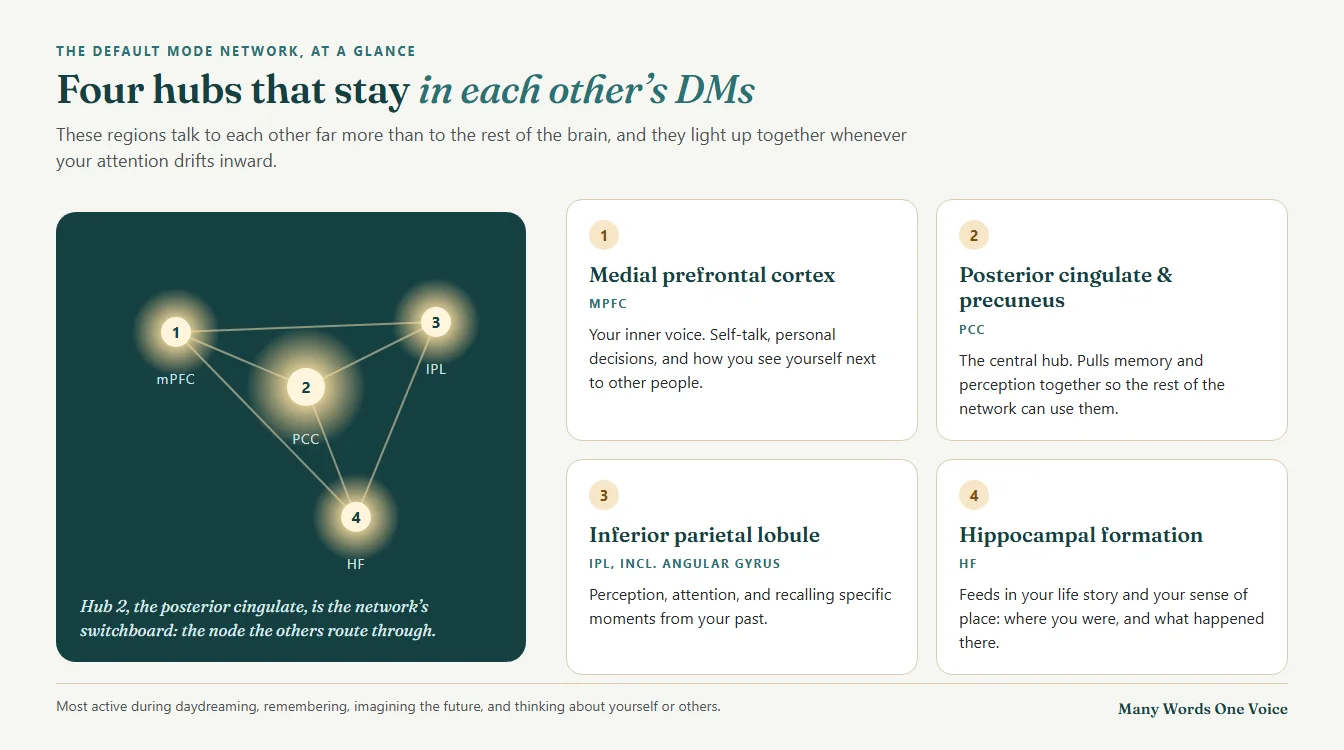
On an anatomical level, it’s the Medial Prefrontal Cortex (mPFC), the Posterior Cingulate Cortex (PCC), the Inferior Parietal Lobule, and the Hippocampal Formation that, by and large, make up the DMN. And these nodes are quite chatty, talking to each other much more than they do with other parts of the brain. Think of them like your gang of friends: you talk with others, yes, but the four of you are always in each other’s DMs.
How Does the Default Mode Network Work?
The DMN works like a team—just like the tight-knit group of ‘Friends’. Everyone brings something to the table, usually something they’re good at.
- mPFC: It handles self-talk, personal decisions, and how you see yourself in relation to others. It is your inner voice of reason (or pandemonium, but more on that down below). You know this is Rachel all the way.
- PCC (and the Precuneus): In charge of integrating memory and perception. Think of it as a central switchboard or a hub. Monica for the win.
- Inferior Parietal Lobule (including the Angular Gyrus): Helps with attention, making sense of what you perceive, and recalling episodic memories. Joey and Chandler.
- Hippocampal Formation: Feeds autobiographical memory and spatial context into the network. You know who it is—Phoebe, bringing up her mom and sister at the most opportune moment.
Research suggests the DMN breaks down into a few smaller subsystems that feed into the whole. But the more pressing question is: how does the DMN as a whole work? Here’s what science has to say so far.
- Much like your car idling in neutral, the resting brain (of which the DMN is a part) keeps burning fuel. An estimated 60–80% of the brain’s entire energy budget goes to this ongoing background activity, while focused tasks add only a sliver on top, as per neuroscientist Marcus Raichle’s paper, The Brain’s Dark Energy.
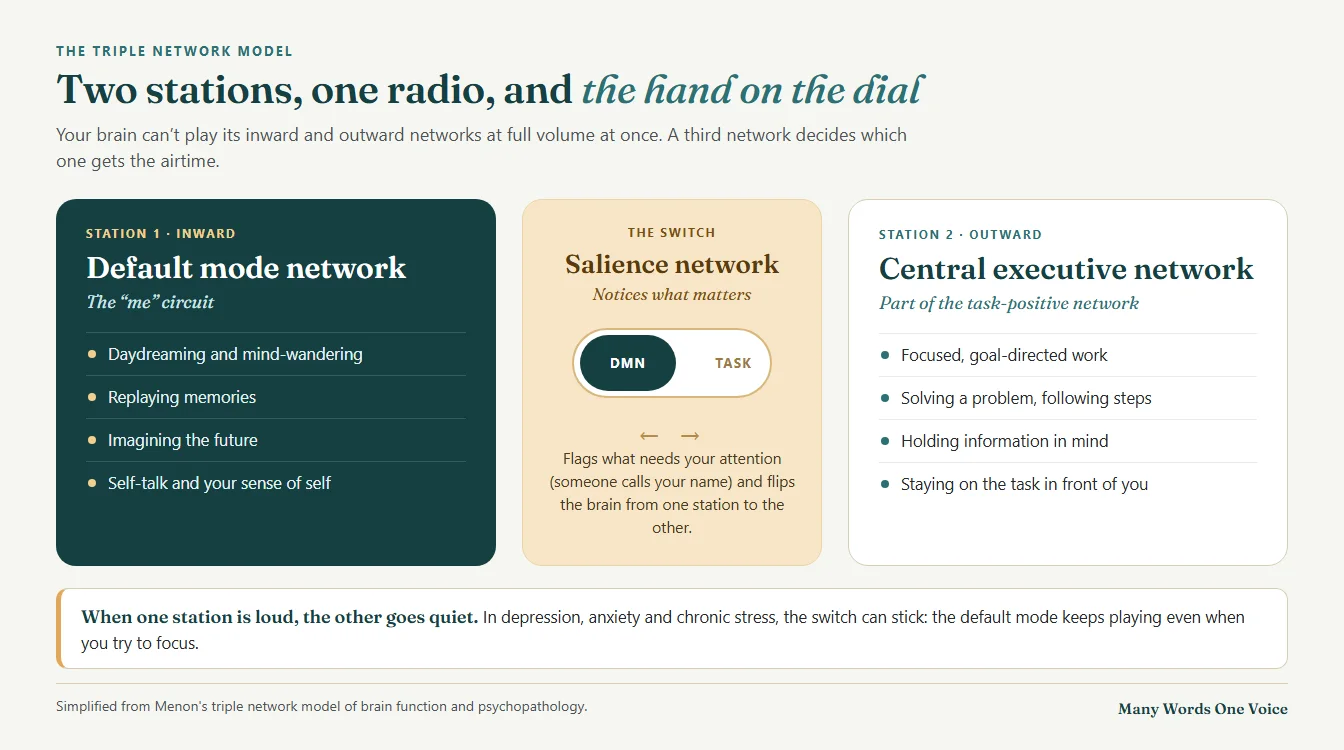
- The Salience Network functions very much like a security camera at the gate, alerting your DMN about a visitor (someone calling your name) and forcing your brain to shift gears.
- The Central Executive Network (CEN) handles focused and goal-directed work, such as solving a math problem or clearing that demanding level in a video game. CEN and DMN are like night and day. When activity in one increases, it diminishes in the other.
The Default Mode Network and Mental Health
Ever looked at a kid and wondered why they go all Donald Duck and you can’t? Part of the answer is that the DMN is still under construction. A primitive version is there from birth, it starts to resemble the adult network around age two, and it keeps maturing through childhood until it reaches full cohesion in early adulthood, as per the study titled: The default mode network throughout the lifespan: A state-of-the-art scoping review on its development and association to individual cognitive functioning.
As it matures, your little one (or niece and nephew) builds out a sense of self. Think likes, dislikes, friendships, and everything else surrounding it that starts in the brain.
As they grow older, their inner voice grows louder, and some end up pretty scared of what it has to say. Others mistake it for mindless chatter or simply dislike what they hear, so much so that they look for exits—think alcohol, drugs, endless partying, binge-scrolling reels, and anything else that distracts from the boredom and the introspection it brings with it.
In fact, some time back, someone asked Claude AI what has fundamentally changed for us humans, and this is what it responded with.
“What has fundamentally changed the world for the worst but us humans haven’t realised?”
The answer is the collapse of unstructured time — and specifically, what smartphones and algorithmic feeds have done to boredom.
For the vast majority of human history, boredom was not a problem to be solved. It was a cognitive state that forced the brain into a mode we now call the “default mode network” — a kind of mental background processing where you consolidate memories, develop empathy by imagining other people’s lives, generate creative ideas, and build a coherent sense of self. When you stared out a window, waited for a bus, or sat quietly after dinner, your brain was doing some of its most important work. Boredom was, in a very real sense, the engine of the inner life.
A response from Claude, as shared by quantumfield.ai on Instagram
It’s no surprise that the ancient Greeks welcomed this so-called boredom, choosing to rest the brain so that it could come up with ideas and solutions. They called it Scholē, and I am pretty sure you have experienced it too when a solution to a problem at work or school pops into your head, after you’ve stepped away from the said problem for a while.
You now know DMN is a net positive, a part of your brain and being, designed to enable key functions such as mental time travel, creative incubation, social radar, and self-referential thinking.
The problem arises when mental health conditions hijack the DMN and the Salience Network, the Task Positive Network (TPN), or the CEN fails to come to the rescue. Consultant psychiatrist Dr. Sanil Rege walks through how this plays out in his video, Can’t Switch Off? The Secret Brain Circuit Behind Overthinking.
- Depression causes the inner voice to change teams and turn into your inner critic. It turns into a radio that blasts negative self-talk 24x7, and there’s no easy way to change the station.
- PTSD triggers flashbacks: unpleasant or outright horrible memories that keep playing in a loop, making it impossible to function normally.
- In ADHD, one leading theory holds that the DMN doesn’t quiet down properly during tasks, so it keeps intruding on the TPN and pulling attention away.
- Schizophrenia, where the inner speech mixed with the DMN can create the illusion of different voices.
- Alzheimer’s, where physiological changes, including plaque deposition, signal an onset.
- Autism, while preliminary research suggests some linkage between DMN and the overall mental condition, the jury is still out on who influences who.
This is precisely where individuals look for an exit ramp.
A quieter inbox. One letter a week.
Wellness that doesn't shout. Every week, one thoughtful letter on rest, resilience, and the small habits that add up. Written with care, backed by evidence.
The Default Mode Network and Depression
We often repeat conversations and events in our head, often without choosing to. And we wonder: could we have said something different, not lost our cool, or not acted the way we did, and so on.
But when it comes to depression, this conversation we have with ourselves undergoes a radical shift. The inner voice, instead of steering our actions, chooses to criticise us around the clock, to the point that it ruins our morale and gets us wishing that the negative self-talk stops permanently. We’ll dig into this further in our upcoming article: Why your brain goes to dark places when idle: The science of Rumination.
Your brain enters and locks into this phase partly because of the subgenual prefrontal cortex (sgPFC), a small region tucked beneath the front of the brain that’s tied to withdrawal and low mood. In people with depression, the sgPFC becomes unusually tightly coupled with the DMN, and the stronger that coupling, the more they ruminate on their depressive symptoms, as per the paper: Depressive Rumination, the Default-Mode Network, and the Dark Matter of Clinical Neuroscience.
What’s worse is that the depressed brain can struggle to hand control back when a task demands attention, which is part of why the loop is so hard to break (Hamilton et al., 2011).
If your inner critic ever starts telling you that you’d be better off gone, please don’t wait it out. In the US, call or text 988 to reach the Suicide & Crisis Lifeline; elsewhere, contact your local emergency number or crisis line.
The Default Mode Network and Anxiety Disorders
In individuals with anxiety disorders, the internal mind can go into overdrive. It makes a mountain out of a molehill, turning mistakes that no one noticed into career-ending catastrophes—in your head. It gives rise to this never-ending sense of worry and an impending sense of doom. As soon as one worry resolves, another crops up to take its place.
Research links anxiety to changes in how several large brain networks, the DMN included, work and talk to each other, as outlined in Functional network dysfunction in anxiety and anxiety disorders. The picture is mixed rather than a simple “DMN on, everything else off”: the DMN can struggle to quiet down when you face a perceived threat or try to focus, which is exactly when worry elbows its way in.
Anxiety disorders also change how the DMN communicates with the amygdala, your brain’s threat detector. The meta-analysis Altered amygdala resting-state functional connectivity in anxiety disorders: a coordinate-based meta-analysis found weaker connections between the amygdala and parts of the DMN in people with anxiety disorders, and links this altered wiring to hallmark symptoms like hypervigilance: the brain actively scanning for threats irrespective of the environment it’s in.
On Many Words One Voice, we’ve covered anxiety in detail. Learn all about it in our piece: Anxiety Feels Endless. Here’s Why — and What Actually Helps.
The Default Mode Network and Stress
A stressed-out brain can look quite similar to an anxious or depressed brain. The near-constant flow of communication between the Salience Network and the DMN not only exhausts the brain, but it also forces the brain into a state of hypervigilance. This brings a whole set of new issues to deal with.
This constant signalling, feelings of fatigue, and the near-constant forced requirement to stay vigilant are some of the reasons why stressed-out individuals make erroneous decisions. We’ll cover this thoroughly in our upcoming article: Chronic stress and the default mode: how trauma alters your inner narrative.
Remember, it’s not the human at fault; it’s the environment they are in. If you’ve ever been really stressed out or just wanted to learn more about stress to better manage it, our piece, Cognitive Burnout and Brain Fog: Causes, Symptoms, and How to Feel Like Yourself Again, is an excellent place to begin.
You can also explore our library on mental and emotional health, and pick a resource that works for you in the present.
The Triple Network Model: DMN, CEN, and the Salience Network
If you are this far into the article, you have a functional understanding of the Default Mode Network and how it operates. You’ve also noticed terms like TPN and CEN and wondered how it all ties together. This is where we answer those questions.
A quick clarification before we proceed: TPN and CEN are not fundamentally different but aren’t the same either. Task Positive Network (TPN) is a set of brain regions that light up when you are actively engaged in doing a task. Loosely speaking, the frontoparietal and dorsal attention networks make up the TPN. The Central Executive Network (CEN) is the set of brain regions that lights up when we are engaged in complex work. CEN is most commonly mapped to the frontoparietal network.
Tl;dr: The CEN is part of the TPN, and they overlap, but they aren’t interchangeable.
With that out of the way, let’s understand how our brain functions with respect to the DMN. Picture your brain as a radio but with no power toggle button of its own. It runs as long as the car runs or there’s an uninterrupted power supply. This radio operates on the AM and the FM frequencies. When it’s not on one, it’s usually on the other.
The relationship between TPN and DMN is similar. When our brain’s not tuned in to one, it’s usually tuned in to the other. When we are actively engaged in a task, it’s the TPN controlling the steering wheel (e.g., me, as I write this piece). Because TPN is active, DMN is not. The moment our brain completes a task or takes a break from one, the brain shifts to the DMN ‘frequency’, and depending on your state of mental health, you might be listening to a pleasant station or otherwise. (The two can cooperate on some tasks, like planning your future, but the basic seesaw holds.)
What’s the role of the Salience Network in all this? Salience Network is the driver in the car, or the listener at home who toggles between the AM and FM frequencies. Just like the radio cannot toggle between AM and FM on its own, our brains cannot toggle between the TPN and DMN all by themselves. It needs the Salience Network, anchored in the anterior insula and the dorsal anterior cingulate cortex, which acts as an operator or a hub, if you will. Neuroscientists call this three-way arrangement the triple network model.
How a Compromised Default Mode Network Shows Up in Daily Life
The WHO, in a September 2025 release on its World mental health today report, highlights how more than a billion people worldwide are living with some form of mental health disorder. The report also notes that mental illnesses affect women disproportionately.
In light of the above, it’s necessary to outline how a compromised DMN shows up so that you are able to get the help you need. Please note that the following list isn’t exhaustive, and it isn’t a diagnostic checklist. Just because what you’re feeling isn’t listed here doesn’t make it any less of a concern.
When in doubt, always reach out—to friends, family, or a licensed therapist near you.
-
Relentless rumination: Uncontrollable negative self-talk. The brain keeps running past mistakes in a loop, attaching more weight to actual or perceived losses compared to actual wins. The person might be at a dinner party or award ceremony, but internally they are dwelling on their personal defects, chipping away at their self-confidence one hurtful phrase at a time.
-
Imagining catastrophes: The compromised DMN turns positive mental time travel negative. Instead of picturing positive outcomes, the brain focuses on the negative. A very common example is thinking your significant other is in an accident just because they are five minutes late and not answering their phone. Or concluding a breakup is on the cards because you had a heated argument with them.
-
Intrusive interference: Taking flights of fancy when undertaking serious tasks, such as performance reviews, quarterly performance meetings, working on a sensitive project, driving, walking, or performing an operation, and not really staying in the present. This is not the same as thinking about the next holiday destination while idly sipping coffee at a café.
-
Auditory hallucinations: Born out of the brain’s inability to differentiate between internal monologue and external reality. The brain mistakes internally generated speech for voices coming from outside the head, which makes them feel all the more real (Barber et al., 2021). This is not the same as the inner voice that either pushes or admonishes us about having an extra cookie while we are trying to watch our weight. If you or someone close to you hears voices others don’t, see a doctor promptly.
-
Intrusive flashbacks: Very vivid and intrusive memories of trauma that transport the individual to a different place in time, mentally. PTSD in combat veterans is perhaps the best-known example. The sound of a car backfiring can instantly place the individual inside their traumatic memory, making it difficult to live normally. Phobia-driven nightmares may also function similarly.
-
Difficulty mentalizing: Mentalizing is the ability to infer what someone else is thinking or feeling based on their body language or tone. When it falters, it leads to difficulties in social communication, showing up in the real world as trouble navigating social nuances or having an inadequate response to someone in distress.
-
Loss of orientation: This is about getting lost in familiar places. Think taking the same route to work for 30 years but then slowly forgetting the way, and getting lost somewhere in between. This is not the same as the loss of orientation that comes with lightheadedness. Getting lost on familiar routes can be an early sign of dementia, so it’s worth seeing a doctor about.
-
Utilitarian moral reasoning: It’s hypothesized that a faulty DMN can cause changes in or alter a person’s moral compass. The individual may start to make extremely utilitarian choices due to a functional disconnect between logic and human emotions. This may look like harming a small group in the name of the greater good for the larger populace.
-
Fixating on cravings: Driven by altered connectivity between the Salience Network and the DMN (Zhang & Volkow, 2019). Shows up as a hyperfixation on internal states of craving or distress. Someone recovering from opioid dependence, for example, may find that every flicker of pain or discomfort pulls their attention straight back to the urge to use.
Establishing Homeostasis: How to Calm an Overactive DMN
If you recognize yourself in any of the above scenarios, pause and take a deep breath.
Having an overactive DMN doesn’t mean your brain is fundamentally broken. It simply means that your internal system has gotten stuck in a state of hypervigilance, trying to protect you from sustained stress, emotional overload, or cognitive pressure.
The goal isn’t to turn off or permanently destroy the DMN. You need it for creativity, empathy, and processing your life story as it unfolds. The goal here is to re-establish homeostasis, i.e., restore the brain to a balanced state.
Here are some accessible steps to help soothe the inner narrator.
-
Shift gears with micro-mindfulness: Tapping into the sensation of your chest rising and falling or your stomach inflating and deflating with every breath pulls attention back into the present. Experienced meditators show quieter DMN activity, as per a study in PNAS. You can also use the 5-4-3-2-1 sensory grounding technique or engage in something simpler—taking two quick breaths through the nose and a slow exhale through the mouth. Helps bring the brain out of DMN overdrive gently.
-
Practice reframing self-talk: Helps with separating facts from fiction. When the inner narrator blows a failure out of proportion, writing down previous wins establishes objective truth—something your brain can’t deny. Same goes for talking kindly to yourself and acknowledging that the inner critic is just that—an inner critic. It’s not you.
-
Guided imagery and mental rehearsal: When a compromised DMN acts up and plays spoilsport, visualise yourself doing something small correctly. It can be as simple as imagining successfully doing all the dishes or folding the day’s laundry. Athletes and soldiers use mental rehearsal to build confidence and sharpen skills before they need them. If you need further details, check out Maya Raichoora (on Instagram as maya.mental.fitness).
-
Awe as a reset mechanism: Inexpensive experiences such as going on a hike, camping, or watching a meteor shower can trigger feelings of awe. In one brain-imaging study, people watching awe-inspiring videos showed reduced DMN activity and less self-focused thinking. Less self-focus means less airtime for the inner critic.
-
Body awareness: Like breath awareness, body awareness can also nudge the CEN to take over. Activities like Yoga, Tai Chi, or simply walking require no special investment. Movement asks the body to coordinate as a whole, pulling the brain’s focus onto the task at hand.
-
Seek out flow states: Research suggests that once a flow state kicks in, activity in self-focused brain regions dips and the ‘ME’ voice fades into the background (Ulrich et al., 2014). To get the ‘Flow state’ going and kickstart the TPN, pick an activity that moderately challenges you. Painting, playing an instrument you are familiar with, or gardening are viable options. Picking something novel may not be the best idea since early failure can reinforce the claims of the inner critic.
-
Nutritional and herbal supplements: Some herbal remedies may help take the edge off stress. Ashwagandha has shown modest reductions in cortisol and perceived stress in small trials; the evidence for Rhodiola Rosea is weaker and mixed. L-theanine may help you feel calmer in the short term (we compare it with other calming options in Supplements for Burnout). These aren’t for everyone: avoid ashwagandha if you are pregnant, and check with your doctor first if you have a thyroid, liver, or autoimmune condition, take sedatives or other regular medication, or (for Rhodiola) take antidepressants or live with bipolar disorder. If herbal options interest you, don’t miss this excellent piece of ours: Adaptogens for Stress: Benefits, Safety, and What Research Shows.
Frequently Asked Questions
Q: What is the default mode network? The default mode network (DMN) is a set of brain regions that work together when you’re not focused on the outside world: daydreaming, remembering, imagining the future, or thinking about yourself and other people. Its core hubs are the medial prefrontal cortex, the posterior cingulate cortex and precuneus, the inferior parietal lobule, and the hippocampal formation.
Q: Is the default mode network good or bad? It’s a net positive. The DMN powers mental time travel, creative incubation, empathy, and your sense of self. Problems start when it gets stuck in overdrive and the brain struggles to switch away from it, which is linked to rumination, chronic worry, and other mental health conditions.
Q: How is the default mode network linked to depression? In depression, the DMN becomes unusually tightly coupled with the subgenual prefrontal cortex, and the stronger that coupling, the more people tend to ruminate on their symptoms. The inner voice turns into an inner critic that is hard to switch off.
Q: What is the triple network model? It’s a way of explaining how three large brain networks share control: the default mode network (inward, self-focused thought), the central executive network (focused, goal-directed work), and the salience network, which notices what matters and switches the brain between the other two.
Q: How do you calm an overactive default mode network? You can’t switch the DMN off, and you wouldn’t want to. Practices that pull attention into the present can help it settle: breath awareness and sensory grounding, reframing negative self-talk, gentle movement, experiences of awe, and activities that put you in a flow state. If your thoughts are affecting daily life, talk to a licensed therapist or doctor.
Your Brain’s Idle State Shapes Your Mental Health
As we conclude this piece, it’s important to point out that the role of the DMN is still under active study. It remains an emergent field, even 25 years after scientists first described it. While the technical research remains inaccessible to us in one form or another, the knowledge that there’s more to mental health than just circumstances is a point of solace.
Equally important is the realization that the fault rarely lies with the individual in question and that incremental changes plus patience can yield rich neuroplasticity benefits.
Your brain’s idle state does shape your mental health, and with baby steps, you get to choose what your DMN thinks and dreams.
Disclaimer: This article is for general wellness and educational purposes only. It is not a substitute for professional medical advice, diagnosis, or treatment. Always consult a qualified healthcare provider before making changes to your health routine, including the use of supplements, especially if you are pregnant, breastfeeding, taking medication, or managing a medical condition.
Related
-

Health Anxiety: Causes, Symptoms and Treatment
Health anxiety is the persistent fear of serious illness despite normal test results. Learn what…
-

How to Have a Relaxing Night at Home — When the Usual Tricks Haven’t Worked
How to have a relaxing night at home when the lavender-and-tea version hasn’t landed. Diagnostic,…
-

Anxiety Feels Endless. Here’s Why — and What Actually Helps.
This guide is meant to help you understand anxiety as a whole — what it…