
Have you ever caught yourself reacting in a way that didn’t feel entirely yours — a flash of anger that echoed your father’s voice, a silence that mirrored your mother’s, a flinch you couldn’t explain? Your blood relation family tree isn’t just a chart of names and dates. It’s a living record of how love was modelled, how conflict was handled, how safety was defined — patterns absorbed before you were old enough to question them.
Research from the American Psychological Association shows that trauma responses can be transmitted across generations through both learned behaviour and biological stress pathways. Understanding your blood relation family tree is the first step toward choosing which patterns you carry forward and which ones you finally put down.
Too drained to read right now? No judgement. Watch ‘Your Family Tree Is Shaping You: Break the Cycle & Heal’ on YouTube
Key Takeaways:
- Your blood relation family tree is more than names and dates — it’s the emotional blueprint that shaped how you learned to love, argue, protect yourself, and define safety before you could choose for yourself.
- Generational patterns like emotional suppression, perfectionism, and conflict avoidance aren’t character flaws — they were survival strategies your family developed under pressure, passed down through observation.
- Researching your family tree isn’t just genealogy — interviewing elders, gathering documents, and noticing recurring themes reveals the “why” behind patterns you’ve carried without understanding.
- Healing doesn’t require cutting off your family — it requires recognising inherited patterns, taking responsibility for your own growth, and building boundaries that protect without punishing.
- Healthy family ties and painful ones can coexist — acknowledging what was good doesn’t erase what hurt, and grieving what was missing doesn’t mean you’re ungrateful.
- You inherited patterns you didn’t choose, but you have the power to choose whether to keep them — healing happens slowly, in small moments of speaking up, setting boundaries, and responding to yourself with compassion.
What Is a Blood Relation Family Tree?
This article is meant to offer language, perspective, and reflection — not replace therapy or professional care. If your family history includes trauma, emotional harm, or patterns that feel heavy to carry alone, a licensed therapist or counselor can help you work through it safely.
A blood relation family tree maps the biological connections between family members — parents, siblings, grandparents, aunts, uncles, cousins, and extended relatives who share your genetic lineage. But this definition only scratches the surface. While genetics certainly matter, a blood relation family tree represents far more than DNA and chromosomes.
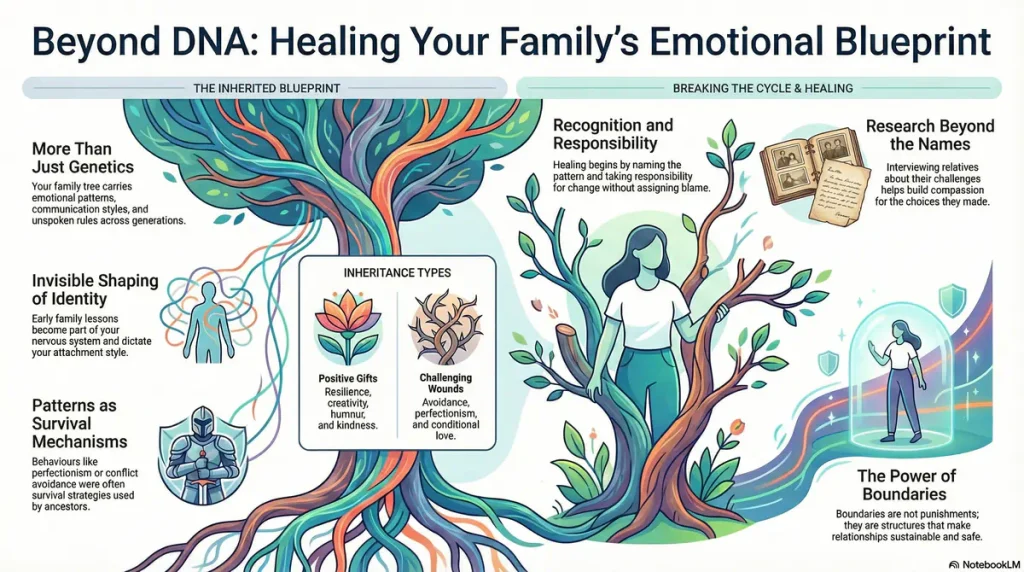
At its core, your blood relation family tree reflects the emotional patterns, communication styles, inherited beliefs, and unspoken rules that have traveled through your family line for generations. It’s the emotional blueprint you inherited before you were old enough to question it. Some of this inheritance serves us well — resilience, kindness, creativity, humor. Some of it doesn’t — patterns of avoidance, silent treatment, perfectionism, or conditional love.
Understanding your blood relation family tree means seeing yourself not as an isolated individual, but as part of a living, breathing system that extends backward through time and forward into your future relationships. It’s about recognizing the roots from which you grew, even when those roots were tangled or scarred.
How Your Blood Relation Family Tree Shapes Your Identity
Family shapes identity in profound and often invisible ways. Before you had a name, before you formed your first conscious memory, your blood relatives were already teaching you how to be in the world. You learned how to handle anger by watching your parents. You learned what safety felt like — or didn’t — in your first home. You absorbed messages about your worth, your lovability, and your place in the family system simply by existing within it.
These early lessons become part of your nervous system, your attachment style, and your internal dialogue. They influence who you choose as friends, romantic partners, and colleagues. They shape how you parent your own children, if you have them. They determine whether you’re someone who speaks up in conflict or disappears, whether you seek help or suffer in silence, whether you believe you deserve good things or expect the worst.
Researchers in intergenerational trauma have documented how deeply family patterns embed themselves. Children of parents who experienced neglect often struggle with the same self-neglect, even when they consciously reject it. Grandchildren of trauma survivors may carry anxiety or hypervigilance they never experienced firsthand. The blood relation family tree acts as a transmission line, carrying both gifts and wounds across the decades.
The good news? Awareness changes everything. Once you see these patterns, you can choose differently. Your blood relation family tree doesn’t determine your destiny — it informs it. Understanding it gives you agency.
Generational Patterns: Breaking the Cycle
Every family has patterns. Maybe your blood relation family tree shows a history of workaholism, where love gets expressed through provision but never through presence. Or perhaps emotional expression was discouraged — feelings were seen as weakness rather than wisdom. Some families pass down perfectionism as a survival strategy. Others normalize conflict avoidance, leaving generations unable to have honest conversations.
These aren’t moral failures. They’re survival mechanisms. Your great-grandmother may have needed to stay silent to survive her marriage. Your grandfather may have worked obsessively because that’s how he proved his worth during the Depression. Your parent may have controlled their children’s emotions because that’s how they learned to manage chaos. Each generation did what it could with what it knew.
This echoes what Bowen Family Systems Theory describes as the multigenerational transmission process — the way emotional patterns pass from parent to child across multiple generations.
But generational patterns aren’t destiny. You have something your ancestors didn’t: visibility. You can see the pattern, name it, and decide if you want to keep it or change it. This is the work of emotional healing — not rejecting your blood relatives, but refusing to inherit their unfinished business.
Breaking these cycles takes intention. It means catching yourself in old patterns and pausing before you react. It means seeking support — therapy, coaching, community — to rewire your nervous system. It means being gentle with yourself when you slip back into familiar habits, because patterns are powerful. And it means celebrating the moments when you respond differently, when you choose a new way, when you break the chain.
A quieter inbox. One letter a week.
Wellness that doesn't shout. Every week, one thoughtful letter on rest, resilience, and the small habits that add up. Written with care, backed by evidence.
How to Research Your Blood Relation Family Tree
If you want to truly understand your blood relation family tree, research goes beyond creating a visual diagram. It means gathering the stories, not just the names. It means learning the contexts that shaped your relatives’ choices.
Start with interviews. Talk to older relatives while you can. Ask them about their childhoods, their parents, the challenges they faced, the values they hold dear. Record these conversations if possible. Ask what they wish they’d done differently. Ask what they’re proud of. The stories behind the branches matter as much as the names.
Gather documents. Birth certificates, marriage licenses, letters, journals, photos — these become the texture of your family history. They show you not just names and dates, but the actual lives your blood relatives lived. A photograph of your grandmother as a young woman might reveal her strength or her sadness in a way a genealogy chart never could. Free tools like FamilySearch.org let you build your family tree using public records, census data, and immigration documents — a useful starting point before diving into the emotional patterns beneath the names.
Notice patterns across generations. As you research, watch for recurring themes. Do multiple relatives struggle with anxiety? Has addiction appeared in several branches? Do certain professions run in families? Has there been a history of divorce or difficult marriages? These patterns aren’t deterministic, but they’re worth understanding.
Explore the historical context. Your blood relation family tree didn’t grow in a vacuum. It grew through wars, recessions, migrations, and cultural shifts. Understanding what your ancestors faced helps you understand why they made the choices they did. It builds compassion.
Create your own documentation. Write down what you learn. Draw your blood relation family tree with stories attached to the names. Make it a living document you return to as your understanding grows. This process itself becomes healing.
The Emotional Weight Your Blood Relation Family Tree Carries
Some blood relation family trees feel light and nourishing — sources of pride, connection, and belonging. But many of us carry heavier histories. Maybe your blood relatives were unavailable emotionally. Maybe there was abuse, addiction, mental illness, or betrayal. Maybe the family system required you to be less than you are — to suppress your talents, your sexuality, your authentic self.
If your blood relation family tree includes trauma, you’re not alone. Intergenerational trauma is real. It doesn’t make you weak or broken. It makes you someone carrying more weight than you ever asked to carry.
The weight shows up in different ways. For some, it’s anxiety that feels groundless until you realize your parent was anxious, and their parent before them. For others, it’s difficulty trusting people, or a deep fear of abandonment, or perfectionism that never lets you rest. Some people find themselves recreating unhealthy relationship dynamics again and again, puzzled by why they keep choosing the same pain.
Emerging research on epigenetics suggests that severe stress can actually alter gene expression in ways that are passed to offspring — meaning your body may carry biological echoes of your ancestors’ experiences.
This is not your fault. You didn’t create these patterns. But you can work with them. You can get curious instead of ashamed. You can get support. You can decide which inherited patterns serve you and which ones need to be released.

Healing From Family Wounds
Healing from family wounds doesn’t mean pretending the wounds never happened. It doesn’t mean forced forgiveness or rekindling relationships that hurt you. Healing from your blood relation family tree means something different for everyone, but it usually includes these elements:
Recognition. You cannot heal what you do not see. The first step is acknowledging: “This pattern exists in my family. This wound is real. This impact matters.” Many people spend years minimizing their family’s dysfunction, telling themselves it wasn’t that bad. But if it hurt you, it was bad enough. Your experience is valid.
Responsibility without blame. This is delicate. Taking responsibility means saying, “I inherited this pattern, and now it’s my job to work with it.” But responsibility is different from blame. Blame says, “My family ruined me.” Responsibility says, “My family taught me certain things, and now I get to choose what to keep and what to change.” The shift from blame to responsibility is incredibly empowering.
Professional support. Healing family wounds often requires more than self-reflection. A good therapist can help you understand your patterns, process your emotions, and develop new skills. You’re not weak for needing help — you’re wise. Your blood relation family tree shaped you for years; you deserve professional support to reshape yourself. If you’re unsure where to start, SAMHSA’s free national helpline (1-800-662-4357) offers confidential referrals to local treatment services and support groups.
Creating new experiences. Your nervous system learned early patterns through lived experience. It can learn new patterns the same way. If your family never had healthy conflict resolution, you can practice it in therapy and in safe relationships. If you grew up with conditional love, you can experience unconditional acceptance from a therapist or support community. New experiences gradually rewire your system.
Grieving what you didn’t get. Healing also means acknowledging loss. Maybe your blood relation family tree couldn’t give you the support you needed. Maybe a parent was emotionally unavailable, or a sibling was lost to addiction, or the family system required you to hide essential parts of yourself. Grieving these losses is not self-pity — it’s honest acknowledgment of real pain. And grief, when it’s fully felt, leads to freedom.
Building Healthy Boundaries With Blood Relatives
Understanding your blood relation family tree doesn’t automatically mean you should maintain close relationships with all your blood relatives. Sometimes, the healthiest choice is to create distance. Boundaries are one of the most loving things you can do — for yourself and for them.
Boundaries are not punishment. A boundary is simply a clear statement of what you will and won’t tolerate. “I won’t participate in conversations that demean other people.” “I need 48 hours to respond to messages.” “I won’t lend money to family members.” “I won’t discuss my relationship with my parents.” These aren’t walls; they’re structures that make relationships sustainable.
The Cleveland Clinic defines healthy boundaries as limits that protect your physical and emotional wellbeing — they’re not about punishment or rejection, but about sustainable relationships.
You can love someone and not be close to them. Your blood relatives may have done their best, or they may have fallen short. Either way, you can honor the connection without sacrificing your wellbeing. You can say, “I love you and I need distance.” It’s a complete sentence.
Boundaries are often met with resistance. When you start setting boundaries with your blood relatives, they may push back. They may tell you you’re ungrateful, dramatic, or cold-hearted. This is normal. Family systems resist change because change feels unsafe, even when the change is healthy. Stay steady. Your boundaries are not cruel — they’re necessary.
Create your chosen family. One of the most healing realizations is that you don’t have to rely solely on your blood relation family tree. You can build authentic connections with people who get you, who support you, who make you feel safe. These chosen family members may matter as much as or more than your biological relatives. This is beautiful and healthy.
When Blood Relation Family Ties Are Healthy
Not all blood relation family trees are sources of pain. Many people grow up in families that provide genuine support, acceptance, and love. If that’s your experience, it’s worth acknowledging as a genuine privilege. It doesn’t mean you’re weak or haven’t struggled. It means you had a foundation that many people lack.
If you have healthy blood relatives, you can still benefit from understanding your family tree more deeply. What did they do right? What values do you want to pass along? What patterns of health and resilience do you want to honor? Understanding the positive inheritance matters as much as understanding the painful parts.
And if you have some relationships that are healthy and others that aren’t, you’re in the majority. Most people’s blood relation family trees are mixed — containing both profound love and significant pain. This is the complex, human reality.
Moving Forward With Your Blood Relation Family Tree
Understanding your blood relation family tree is not a one-time project. It’s an ongoing journey of discovery, reflection, and healing. As you move forward, remember these truths:
You are not responsible for your family’s wounds. But you are responsible for your own healing. You inherited patterns you didn’t choose, but you have the power to choose whether to keep them. Your blood relation family tree is part of your story, but it’s not the whole story. You are far more than your family history.
Healing happens slowly, in small moments. One conversation where you speak up instead of staying silent. One relationship where you set a boundary instead of tolerating disrespect. One day where you respond to yourself with the compassion you wish your family had shown. These small moments accumulate into transformation.
You don’t have to do this alone. Whether through therapy, community, books, or trusted friends, support exists. Ask for help. It’s a sign of strength, not weakness.
FAQ’s
Q: What is a blood relation family tree? A blood relation family tree maps the biological connections between family members — parents, siblings, grandparents, aunts, uncles, and cousins — while also reflecting the emotional patterns, communication styles, and beliefs passed down through generations. It’s both a genetic record and an emotional inheritance.
Q: How does your family tree affect your personality? Your blood relation family tree shapes how you handle conflict, express love, set boundaries, and respond to stress. These patterns are learned through childhood experience rather than through genetics alone. Recognizing inherited behavioral patterns is the first step toward choosing different responses.
Q: Can you heal from a toxic family dynamic? Yes. Healing starts with recognizing inherited patterns without blaming yourself for them. Setting boundaries, building self-awareness through therapy or coaching, and creating intentional relationships outside the family system all help break cycles that no longer serve you. A licensed therapist who specialises in family systems can help — Psychology Today’s directory lets you search by specialty, insurance, and location.
Q: Why do family patterns repeat across generations? Because patterns are learned through observation before we’re old enough to question them. Children absorb how their parents handle emotions, conflict, and love — then carry those patterns into adulthood unless they actively examine and reshape them through awareness and practice.
Q: How do I research my blood relation family tree? Start by interviewing older relatives to gather their stories, not just names. Collect documents like birth certificates, letters, and photographs. Notice patterns across generations. Explore the historical context your ancestors lived in. Create your own documentation as you learn. The stories matter as much as the structure.
Q: What if I need to set boundaries with blood relatives? Boundaries are healthy and necessary, not punishment. You can love someone while maintaining distance. Be clear about your boundaries, expect resistance, and remember that you don’t have to rely solely on your blood relation family for belonging. Building chosen family is powerful and healing.
Disclaimer: This article offers reflection and perspective on family dynamics and intergenerational patterns. It is not a substitute for professional mental health care. If you’re experiencing significant emotional distress, trauma, or struggling with family relationships, please reach out to a licensed therapist, counselor, or mental health professional who can provide personalized support.
Related
-

How to Build Self-Worth as a Woman – Without Performing it
Self-worth isn’t a confidence hack. This covers where self-doubt starts, how family patterns shape it,…
-

How to Be a Strong Mother: Real-Life Ways to Build Emotional, Mental, and Family Strength
Many women quietly wonder how to be a strong mother as they juggle love, responsibility,…
-

Accept Sadness — Because Every Tear Tells Your Story
Sadness isn’t a weakness—it’s a natural emotional response that carries meaning. This gentle guide explores…